Webinar - Introducing OnPing Plunger - Powered by Pak AI | Oct 29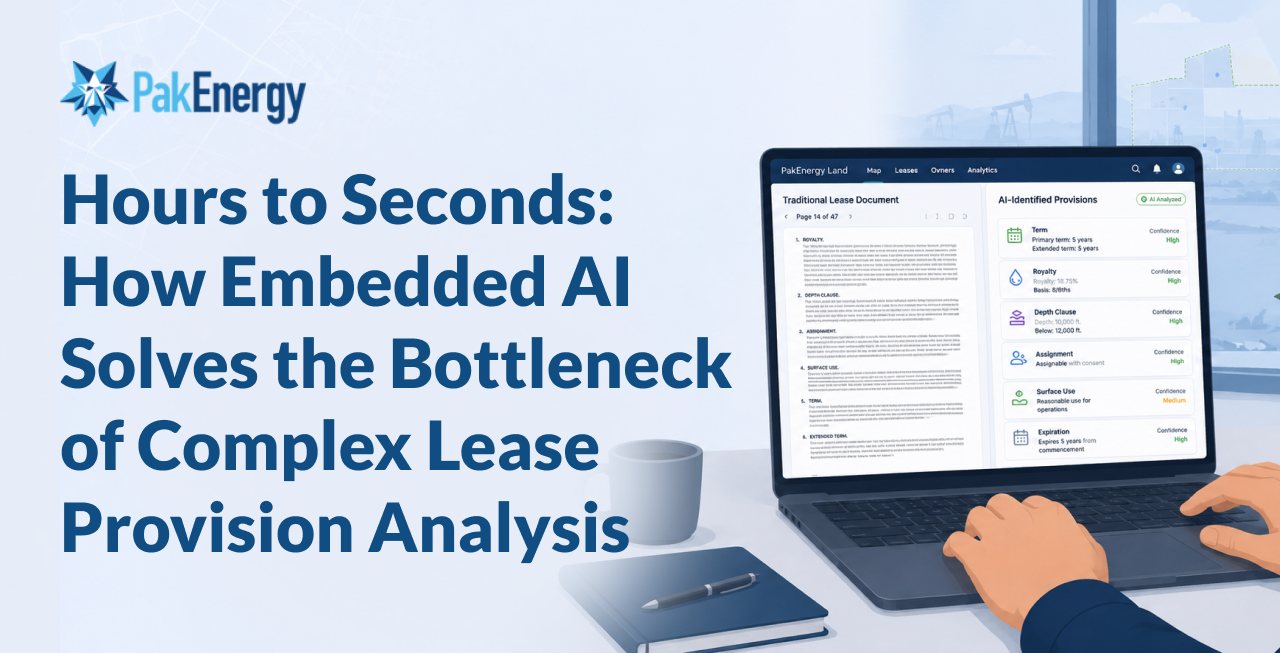
Lease analysts know the moment. A new acquisition lands on the team's desk, the data room opens, and suddenly there are hundreds or thousands of documents waiting for review. Somewhere inside those leases are the provisions that could shape what happens next: obligations, expiration language, acreage descriptions, renewal terms, payment requirements, depth and Pugh clauses amongst many others that deserve a closer look.
Finding them has traditionally required a lot of human attention. That expertise is indispensable, but spending hours searching documents for the right provision is not necessarily the best use of resources. When portfolios grow or an acquisition compresses the timeline, manual lease review can become a bottleneck between having the documents and actually understanding the asset. This is one place where AI has a practical role in land management. Not as a replacement for the lease analyst, and certainly not as a substitute for legal interpretation, but as a much faster way to surface information for expert review.
PakEnergy has moved that capability directly into its oil and gas land management software. The company's embedded AI-powered lease provision capability is designed to identify provisions within lease documents and accelerate research that previously required substantial manual review. PakEnergy describes the shift in unusually concrete terms: hours to seconds.
For Landmen and Lease Analysts facing growing portfolios, tighter deal timelines, and piles of complex documents, that changes the conversation around AI. The question is no longer whether a chatbot can summarize a lease. It is whether AI can remove part of the document-search bottleneck while leaving the judgment where it belongs, with the land professional.
Why Lease Provision Analysis Becomes a Bottleneck
Oil and gas leases are not standardized data records. They are legal documents created across different periods, jurisdictions, counterparties, and transactions. The language that matters may be sitting inside a neatly searchable PDF, buried in an exhibit, or contained in an older document that is much less cooperative.
The complexity is not theoretical. The Bureau of Land Management notes that some acquired private leases it administers date back to the 1880s and may be handwritten or difficult to read. In cases where lease terms are unclear, BLM guidance acknowledges that legal interpretation may be necessary.
For a commercial land department, the documents will be different, but the underlying challenge is recognizable. Before important lease information can be acted upon, someone has to find it, understand its context, and determine what belongs in the land system. Now multiply that work across an acquisition. A provision that takes a few minutes to locate may not seem burdensome. Repeat the process across hundreds or thousands of documents, with several provisions requiring attention in each, and the arithmetic changes quickly. That is where deal velocity begins running into document velocity.
What AI Lease Analysis Actually Changes
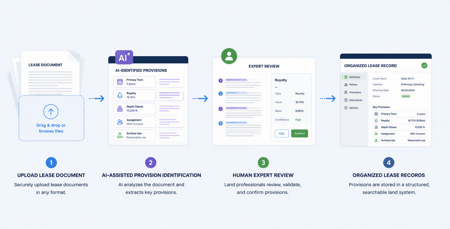
The most useful way to think about AI lease analysis is not, "AI reads the lease so the analyst doesn't have to." That overstates what the technology should be responsible for. A better model is AI-assisted research. The technology works through the document to identify information that deserves attention, while the analyst reviews the result in context and remains responsible for the underlying record and decisions that follow.
PakEnergy's approach follows that model. Its embedded AI capability allows users to add documents directly within PakEnergy Land and uses AI to flag key lease provisions. PakEnergy also states that the system can analyze thousands of documents in minutes and surface critical obligations for land teams. Just as important is what PakEnergy does not say: that AI replaces professional judgment. Its own product messaging makes the division of responsibility clear. AI speeds the research, while the user remains the source of truth. That distinction matters in lease administration because finding language and interpreting its legal effect are two different jobs.
The Difference Between Finding a Provision and Interpreting One
 Suppose an analyst needs to identify leases containing a particular obligation or depth-related provision. In a traditional workflow, the first task may simply be locating the relevant language across the portfolio. That is search work before it becomes analysis work.
Embedded AI can compress the search portion by surfacing provisions for review. The analyst can then focus on the work that actually requires land expertise: checking the provision against the complete lease, understanding amendments or related instruments, validating the extracted information, and determining what action belongs in the land record.
This human review is especially important when documents are ambiguous, incomplete, amended, or connected to other instruments. Government land-record practices offer a useful reminder of how much context can matter. The BIA Branch of Land Titles and Records, for example, maintains official records of documents affecting title to Indian trust and restricted lands, including leases, rights-of-way, deeds, probate orders, surveys, and plats. A lease may be one important document within a much larger record. AI can help a professional get to the relevant language faster. It does not make that surrounding context disappear.
Why Embedded AI Matters More Than Another Standalone Tool
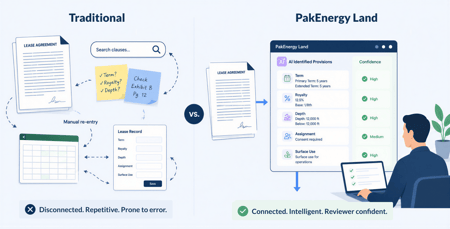
Land teams already have enough tabs open. A standalone AI tool can create an awkward new workflow if analysts have to remove lease documents from the system where they normally work, upload them somewhere else, review the output, and then manually move the useful information back into the land record. The technology may be impressive while the process around it creates another handoff.
Embedding AI within the land management environment addresses that problem differently. PakEnergy's AI lease provision capability is built directly into PakEnergy Land, allowing users to work with documents from within the existing system rather than adopting a separate application solely for provision research. That fits a broader direction across oil and gas software, automation becomes considerably more useful when it is connected to the operational workflow where people already manage the underlying information.
For Landmen, this is an important evaluation point. Speed matters, but workflow matters too. Saving time on document research has less value if the team gives part of that time back through exports, re-entry, duplicate records, or another disconnected application.
Where Faster Provision Research Matters Most
Routine lease administration benefits from faster research, but the impact becomes particularly noticeable when workload arrives in waves. M&A is the obvious example. An acquisition can introduce a large portfolio of unfamiliar documents at once. Land teams need to understand what they have acquired, identify provisions and obligations that require attention, and organize information quickly enough to support onboarding and ongoing administration.
PakEnergy specifically positions its AI lease provision capability for large portfolios and acquisition and divestiture activity. Its Land platform also supports lease records, scheduling and obligation management, eCalendar functionality, GIS, virtual data rooms, and third-party integrations. Faster provision identification can therefore become part of a broader asset-onboarding process rather than an isolated document exercise.
The same principle applies outside M&A. A land team researching obligations across an existing portfolio should not have to begin every question by manually opening lease after lease. When AI can narrow the search space, analysts can spend more of their day resolving the exceptions and ambiguities that actually require their experience.
Speed Does Not Remove the Obligation
One risk with any discussion of AI is allowing "faster" to quietly become "automatic." Lease administration does not work that way. Federal leases provide a useful illustration of why obligations deserve careful attention. According to Bureau of Land Management oil and gas leasing guidance, federal oil and gas leases carry terms, stipulations, rental requirements, and other responsibilities. BLM notes that subsequent rental payments must be received by the lease anniversary date and that failure to make timely rental payments can result in automatic termination.
Private, state, federal, Tribal, and allotted leases can involve very different requirements. The point is not that every land team faces the same obligation. It is that the relevant language matters, and finding it quickly does not eliminate the need to understand it correctly. AI should make the analyst faster at getting to the work. It should not pretend the work no longer requires an analyst.
Turning AI Speed Into Better Land Decisions
 The real measure of AI lease analysis is not how quickly a model can process a PDF. It is what the land team can do with the time and visibility it gains. If analysts can surface relevant provisions sooner, they have more room to investigate exceptions, validate obligations, prepare acquired assets for onboarding, and address questions before they become last-minute problems. Landmen also gain a more scalable research process when portfolio size changes faster than headcount.
That is a more grounded promise than autonomous lease management, and a more useful one. PakEnergy's embedded approach is particularly relevant because it connects AI-assisted provision research with the system where land teams already manage lease records and obligations. The AI accelerates the first pass. The land professional supplies the context, verification, and judgment. For an industry built on documents where a few lines of language can carry consequences for years, that division of labor makes sense.
The Bottom Line
Manual lease review has never been slow because land professionals lack expertise. It is slow because expertise has traditionally been forced to spend enormous amounts of time searching for the information that needs attention. Embedded AI changes that part of the equation.
PakEnergy's documented lease provision capability can identify key provisions within PakEnergy Land and process large document volumes far faster than traditional manual research. It does not eliminate professional review, nor should it. Instead, it gives Landmen and Lease Analysts a way to spend less time hunting through documents and more time applying the knowledge that makes their work valuable. Hours to seconds is an attention-grabbing improvement. The more important shift is what happens to those recovered hours. They go back to the land team.
Ready to See AI-Assisted Lease Analysis in Action?
See how PakEnergy Land brings AI-powered lease provision research into the land management workflow, helping teams surface critical information faster while keeping land professionals in control of the record. Schedule your exclusive demo.
FAQs
What is energy land management?
Energy land management is the process of administering land records, ownership information, leases, easements, GIS data, and related documentation for energy assets, including oil and gas operations and renewable energy projects.
What is AI lease analysis?
AI lease analysis uses artificial intelligence to identify and surface information within lease documents for professional review. In land management, it can reduce the time analysts spend manually searching documents for provisions, obligations, and other relevant lease information.
What can PakEnergy's AI lease provision capability do?
PakEnergy states that its embedded AI capability can analyze lease documents, flag key provisions, surface critical obligations, and process thousands of documents in minutes. The capability is built directly into PakEnergy Land.
Does PakEnergy AI replace lease analysts or legal review?
No. PakEnergy explicitly positions the user as the source of truth. AI accelerates provision research, while land professionals remain responsible for reviewing information in context and determining what actions should follow. Questions requiring legal interpretation should still receive appropriate legal review.
How quickly can PakEnergy analyze lease provisions?
PakEnergy states that its embedded AI lease provision capability reduces complex lease provision research from hours to seconds. Its Land datasheet also states that users can analyze thousands of documents in minutes.
Can AI lease analysis help during acquisitions and divestitures?
PakEnergy specifically identifies acquisitions and divestitures as use cases for its AI lease provision capability. Faster document research can help land teams work through large acquired portfolios and surface provisions requiring further review during asset onboarding.
Why is embedded AI useful for land teams?
Embedding AI within the land management system reduces the need to move documents into a separate application simply to perform provision research. PakEnergy's capability is built into PakEnergy Land, allowing AI-assisted research to take place within the existing land workflow.
Sources & Additional Information
- General Oil and Gas Leasing Instructions Bureau of Land Management - https://www.blm.gov/programs/energy-and-minerals/oil-and-gas/leasing/general-leasing
- Branch of Land Titles and Records Bureau of Indian Affairs - https://www.bia.gov/bia/ots/dtaot/bltr