Webinar - Introducing OnPing Plunger - Powered by Pak AI | Oct 29
Accurate field data provides the foundation of effective decision-making in today’s oil and gas industry. Success in the energy sector is driven by tight margins and top-notch efficiency, which means that operators need reliable production insights to optimize performance.
With oil and gas production software, operations teams can transform raw numbers into actionable insights, providing the clarity to make confident decisions and boost the company’s bottom line.
The Vital Role of Precise Production Numbers
Without accurate data, oil and gas operations are far too prone to error. Issues like incorrect measurements or poorly integrated systems can cause a myriad of problems down the line. For example, inaccurate readings can lead to misallocated revenue, operational delays, and regulatory challenges.
Engineers, managers, and executives all rely on trustworthy data to do their jobs. If they don’t have full visibility into real-time field data, they can’t accurately forecast outcomes, leaving the entire company at an operational disadvantage.
The Challenges of Capturing Accurate Well Data
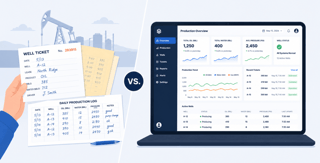 Capturing precise, live field data isn’t always easy. If it were, everyone would already be doing it! Many operators balance hundreds or even thousands of remote wellsites, making it tricky to collect and analyze data.
First and foremost, companies that still rely on manual data entry or siloed databases have many self-imposed challenges that could be resolved by adopting oil and gas production optimization software. Manual logs and paper tickets introduce opportunities for delays and human error, while disconnected databases make it difficult to analyze and validate production data.
Furthermore, field instruments can be touchy, requiring regular calibration to maintain their accuracy. For companies with large numbers of far-flung wells, it can be difficult to track regular maintenance requirements without using software for oil and gas field operations.
How the Best Production Software Improves Data Capture
Modern oil and gas software automates and enhances a company’s entire data ecosystem, from initial readings on well-site sensors to financial and regulatory reports for external stakeholders. Here are a few of the important ways oil and gas software can help operators optimize production.
Real-Time SCADA Integration
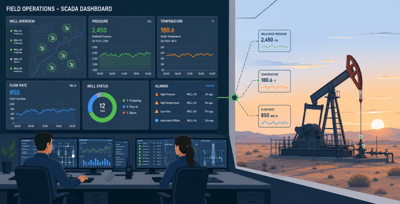 SCADA systems enable companies to monitor a variety of well conditions in real time, including pressure, temperature, and flow rate. When operators leverage oil and gas software with built-in SCADA features, they can continuously collect data and set up automated alerts that notify personnel when the system detects anomalies.
Automated Data Validation
The best oil production software automatically validates data to help detect outliers and inconsistencies. This helps production teams optimize output and assists downstream personnel in producing financial and regulatory reports that accurately reflect field performance.
Centralized Production Dashboards
Instead of flipping back and forth between siloed spreadsheets and disconnected systems, operators with access to oil and gas software benefit from centralized data where they can easily compare performance trends.
Seamless Reporting
Integrated oil and gas production reporting software tools generate standardized, configurable reports for both external regulators and internal stakeholders. When everyone knows they can rely on verified, timestamped data, there are far fewer opportunities for disagreements and disputes.
PakEnergy: The Right Production Platform for Your Needs
Today’s energy industry demands precision and transparency. Without advanced oil and gas production software, operators put themselves at a significant disadvantage compared to competitors who leverage these solutions.
PakEnergy’s comprehensive production platform provides oil and gas producers with better operational control and stronger financial outcomes. Book a free demo today to learn more!