Webinar - Introducing OnPing Plunger - Powered by Pak AI | Oct 29
For years, oil and gas companies have been told that visibility is the goal. More dashboards. More reports. More alerts. More ways to see what is happening across wells, tickets, invoices, and assets. That visibility matters, but it is no longer enough by itself.
Operations and IT executives are now facing a different problem. The data is there, but the next step still depends on someone noticing the issue, interpreting it correctly, assigning follow-up, and tracking it through resolution. A dashboard might show a production outage. A report might reveal a billing discrepancy. A monitoring tool might flag an abnormal pressure trend. But if action still happens manually, the business remains limited by human bandwidth.
That is where Agentic AI changes the conversation. While Generative AI has captured attention for its ability to summarize reports, answer questions, and assist with written content, Agentic AI represents a more action-oriented model. It is designed to monitor conditions, identify exceptions, recommend next steps, and support workflows within rules defined by the business.
For oil and gas leaders, the shift is not about handing over control to AI. It is about building systems that help experienced teams act faster, with better context and stronger oversight.
What is Agentic AI in oil and gas?
Agentic AI refers to AI systems designed to pursue a defined objective within a governed workflow. In oil and gas, that could mean monitoring production data, identifying an exception, recommending a review, prompting escalation, and helping track whether follow-up occurred. That is different from a chatbot.
A chatbot may answer, “Why did production drop on Well 14?” In a future-state workflow, an AI agent could support the next step by flagging the issue, recommending review, and prompting escalation based on rules configured by the business.
The important phrase is “governed workflow.” Agentic AI should not be framed as fully autonomous decision-making. The AI Risk Management Framework, published by the National Institute of Standards and Technology (NIST), emphasizes trustworthy AI, risk management, transparency, and accountability, which are especially important in operational environments that require reliability and security.
Why dashboards alone are not enough anymore
Most operators already have more information than they can reasonably manage. Production systems generate readings. SCADA systems track equipment and field conditions. Accounting platforms capture transactions. Transportation tools manage dispatch, tickets, and billing. Land systems track deadlines and obligations.
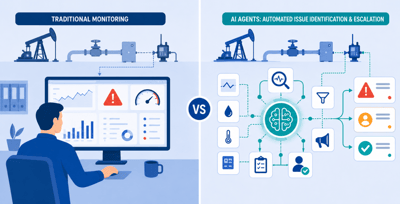 The problem is no longer just data collection. It is execution. A production supervisor may have a dashboard showing downtime, tank levels, and well performance. A controller may have exception reports showing invoice issues or suspense balances. An IT leader may see connected systems expanding across field and office workflows. Everyone has visibility, but that visibility often creates more work. Someone still has to decide what matters first.
Agentic AI could help reduce that burden in future-state workflows by prioritizing exceptions and supporting approved next steps. Instead of asking people to monitor every dashboard and report, the system can surface the issues that need attention and help coordinate the first steps toward resolution. That is why the foundation matters. Companies with connected operational systems, clean data flows, and disciplined workflows are better positioned to adopt more advanced automation when they are ready.
PakEnergy’s oil and gas production software supports oil and gas production reporting, field data capture, real-time field data, and automated reporting workflows.
How is Agentic AI different from predictive analytics?
Predictive analytics and Agentic AI are related, but they are not the same thing. Predictive analytics helps organizations anticipate what may happen. For example, it might identify a well trending toward under performance or a piece of equipment that may need review.
Agentic AI is designed to go a step further by helping coordinate what happens next, when the right data, governance, and workflow rules are in place. If the system identifies a likely issue, an AI-assisted workflow could recommend review, notify the responsible person, attach relevant context, and track the response. The distinction is practical. Predictive analytics points to a likely issue. Agentic AI is designed to help move the next step into motion.
That matters because many oil and gas teams are already stretched thin. Insights are helpful, but they only create value when someone has time to act on them.
A production outage example from the field
Picture a producing well that begins showing an abnormal decline. In a traditional dashboard environment, the production data may appear on a screen that someone reviews later in the day. If the issue is obvious, a supervisor may call the field team. If the pattern is subtle, it may sit unnoticed until a daily report is reviewed or a variance is questioned.
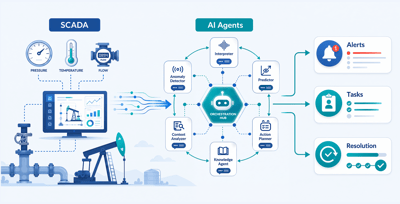
In a future-state agentic workflow, the process could look different. As production data flows into the monitoring platform, the system could compare current performance against historical trends and predefined thresholds. When the abnormal decline appears, an AI-assisted workflow could flag the deviation, recommend review, and surface supporting context such as recent downtime history, SCADA signals, and prior production trends. The operational decision still belongs to the team. A system should not make critical production choices without oversight. But the administrative coordination that slows response can be reduced.
This is where Agentic AI becomes practical. It is not replacing field judgment. It is helping ensure the right people see the right issue with the right context before hours are lost.
Why SCADA and field data capture matter
Agentic AI is only useful if the underlying data is reliable. That is why SCADA, field data capture, mobile production reporting, and operational workflows matter so much. SCADA systems can provide signals from the field. Field data capture tools can add human context, such as comments, inspection notes, run tickets, and downtime explanations. Production software can organize that data into a usable operational record.
PakEnergy’s OnPing SCADA works with Pak Production to produce reliable production numbers and monitor field equipment data. When these systems are disconnected, AI has to work through gaps. When they are connected, an AI-assisted workflow has cleaner context for action.
For example, an outage alert is more useful if the system also knows whether a field note was entered, whether a recent workover occurred, whether similar downtime happened last month, and who is responsible for the asset today. Without that context, the alert may be technically accurate but operationally incomplete.
A billing-error example that executives will recognize
The same concept applies beyond production. Consider a billing issue in an oil and gas accounting workflow. An invoice comes in for a field service job, but the coding does not match the approved project structure. The amount may be close enough to slip through a manual review, especially during a busy close cycle. Later, the discrepancy surfaces in a variance report or partner billing question. That is the old pattern. Catch it late. Research it manually. Pull in accounting, operations, and sometimes the vendor. Then try to rebuild what happened.
In organizations adopting Agentic AI principles, accounting workflows may eventually be configured to identify coding discrepancies, gather supporting documentation, and route exceptions for review before they move further through the approval process.
The AI is not replacing accounting judgment. It is reducing the time between error detection and resolution when the right workflow, governance, and system controls are in place. PakEnergy’s oil and gas accounting software supports specialized oil and gas accounting workflows, including JIB, AFE management, revenue distribution, AP/AR, and financial reporting.
Where PakEnergy’s verified AI capabilities fit today
 It is important to separate today’s verified capabilities from the broader Agentic AI vision.
PakEnergy has publicly announced PakCAPTURE, an AI-powered ticket and receipt management solution for bulk trucking workflows. PakEnergy describes PakCAPTURE as supporting real-time data capture, streamlining ticket and receipt management, and reducing paperwork for drivers and office teams. That is a strong example of practical AI in energy operations. It focuses on capturing and processing operational documents more efficiently, not on autonomous field decision-making.
This distinction matters. PakEnergy’s current AI positioning is best described as AI-powered workflow support and intelligent automation in specific areas. The broader Agentic AI concept points toward where integrated operational platforms may evolve next, especially as companies connect production, accounting, transportation, and field workflows more tightly.
PakEnergy’s platform supports core oil and gas workflows across production, accounting, transportation, land, and other operational areas. That connected environment can provide a stronger foundation for future AI-assisted workflows than disconnected spreadsheets and stand-alone tools.
Why Operations and IT executives are paying attention
The appeal of Agentic AI extends across both operations and technology teams, although for different reasons. Operations leaders are focused on uptime, production continuity, field responsiveness, and reducing the number of small issues that grow into larger disruptions. They want systems that help people respond faster without burying them in more alerts.
IT leaders are evaluating Agentic AI through a different lens. They care about scalability, security, governance, integration, and auditability. They need to know where the system can act, where it cannot act, who approves changes, and how actions are logged. Both groups are right.
Agentic AI only works if it is useful to operations and trustworthy to IT. That means clear rules, defined permissions, strong monitoring, and human oversight for high-impact decisions.
Scaling without adding headcount
One of the strongest arguments for Agentic AI is not futuristic. It is practical. Oil and gas organizations are being asked to scale operations without adding administrative headcount at the same pace. More wells, more tickets, more data, more owners, more invoices, more exceptions. The workload expands quickly, but experienced people are not always available to absorb it. That is where AI-assisted workflows may help.
The first wave of value often comes from reducing coordination work. Not strategy work. Not expert judgment. Just the repetitive follow-up that clogs the day.
- Who needs to review this outage?
- Who owns this invoice exception?
- Has anyone responded to this task?
- Is this issue aging past the threshold?
- Should this be escalated?
Those are the kinds of tasks that drain time from experienced teams. When systems help manage this coordination layer, people can focus on the work that actually requires expertise.
Governance is what makes Agentic AI useful instead of risky
The more action-oriented AI becomes, the more governance matters. A dashboard can be wrong and still leave the decision to a person. An AI agent that initiates workflows or escalates issues needs stronger controls. That does not mean adoption should stop. It means implementation should be deliberate. Strong governance includes:
- Defined approval thresholds
- Clear user permissions
- Audit trails for AI-triggered or AI-assisted actions
- Human review for critical decisions
- Regular monitoring of system performance
- Escalation rules that are visible and documented
For oil and gas, governance is not red tape. It is what allows AI-enabled workflows to operate safely across production, accounting, transportation, and compliance.
Where oil and gas teams should start
Forward-thinking companies are not trying to automate the entire oilfield overnight. That is a good thing. The best starting points are narrow, measurable, and tied to existing pain. Good use cases include:
- Production outage review
- Downtime review workflows
- Invoice exception routing
- Revenue reconciliation follow-up
- Field ticket validation
- Maintenance task triage
- Compliance documentation reminders
Each of these areas has a clear trigger, a defined owner, and a measurable outcome. That makes them well suited for early AI-assisted workflow design. The goal is not to create a fully autonomous organization. The goal is to reduce the lag between signal and action.
The Bottom Line
Oil and gas has spent years investing in visibility. Dashboards, reports, SCADA feeds, mobile apps, and analytics tools have made it easier to see what is happening across the operation. The next advantage will come from acting faster on that visibility.
Agentic AI points toward a future where systems can help flag production issues, support outage response, identify billing exceptions, route tasks, and track resolution within governed workflows. That is the real shift. Not AI as a novelty. Not AI as a chatbot. AI as an operational support layer that helps experienced teams move faster, stay aligned, and scale without adding chaos.
See how PakEnergy helps energy companies build the connected operational foundation needed for intelligent automation across production, accounting, transportation, and field workflows. Or explore our resources to learn how AI-powered tools and integrated data workflows are shaping the next phase of oil and gas operations.
FAQs
What is Agentic AI in oil and gas?
Agentic AI refers to AI systems designed to monitor conditions, identify exceptions, and support action within defined business rules and governed workflows.
How is Agentic AI different from Generative AI?
Generative AI answers questions or creates content. Agentic AI is designed to help coordinate action by recommending next steps, triggering workflows, or escalating issues when predefined conditions are met.
Does PakEnergy currently offer full Agentic AI?
PakEnergy offers AI-powered workflow support through PakCAPTURE for ticket and receipt management. Full Agentic AI, as described here, should be understood as an emerging direction for the oil & gas industry. PakEnergy's end-to-end capabilities today form the foundation to build agentic capabilities for the future.
Can Agentic AI replace operations teams?
No. Agentic AI supports human teams by reducing manual coordination and surfacing issues earlier. Critical operational decisions should remain under human oversight.
How can Agentic AI help with production outages?
In a governed workflow, Agentic AI could monitor production patterns, flag abnormal declines, recommend review, and help route the issue to the right team.
How can Agentic AI help accounting teams?
Agentic AI principles could support accounting teams by identifying billing exceptions, invoice mismatches, missing documentation, or reconciliation issues, then routing those items to the right reviewer.
Why does governance matter for Agentic AI?
Because Agentic AI is action-oriented, organizations need clear permissions, audit trails, human review points, and documented escalation rules.
Sources & Additional Information
- NIST, AI Risk Management Framework. https://www.nist.gov/itl/ai-risk-management-framework