Webinar - Introducing OnPing Plunger - Powered by Pak AI | Oct 29
Digital transformation in oil and gas rarely fails because leaders do not see the value. It slows down because “working” systems are already in place, field teams are stretched thin, and no one wants to disrupt production to swap tools.
That hesitation is understandable. However, it leads to hidden costs that affect day-to-day operations. For example, when an operator acquires new assets, teams often struggle to integrate production data from disparate systems, resulting in delays and additional manual work. These costs do not usually appear on a budget line, but manifest as decision latency, rework, heightened unplanned downtime risk, and slower scaling when the business grows or adds new assets.
For Operations Directors and Operations Executives, the key question is not “Should we modernize?” It is “What is the opportunity cost of waiting another quarter, another year, or another acquisition?”
This article breaks down the hidden costs in operational terms. No hype. No fearmongering. Just the practical tradeoffs that determine whether an operation stays agile or gets buried under manual work.
1. Decision Latency Becomes Your Default Operating Mode
In a modern operation, timing is a competitive advantage. The challenge is that many organizations still make decisions using data that is late, incomplete, or trapped in separate systems.
You see it when:
- Field data arrives at the end of shift, end of day, or end of month.
- Production reporting requires manual consolidation before leadership trusts it.
- Engineering and operations debate which numbers are "the real ones."
- Variance analysis happens after the window to act has passed.
When decision-making depends on delayed reporting, leadership ends up driving the business through the rear-view mirror. The operation may still run, but it reacts instead of leading.
2. Data Silos Create Rework and Invisible Friction Across Teams
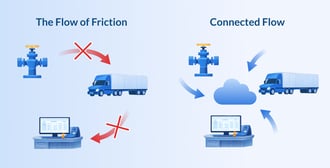
Most “digital transformation” conversations start with software.
If production data capture, downtime notes, run tickets, maintenance history, and allocation inputs live in different places, teams spend time translating instead of executing. Every hand-off introduces friction:
- Field to office
- Operations to accounting
- Engineering to maintenance
- Asset team to leadership
Silos also create a cultural cost. People learn to distrust data, so they keep private spreadsheets “just in case.” That protects individuals in the short term, but it increases organizational drag.
A connected platform changes that dynamic by creating a shared source of truth. It is not about forcing everyone into the same report. It is about making sure everyone is drawing from the same data.
3. Manual Work Expands Faster Than Production Does
One of the most common “hidden” costs is headcount pressure that is disguised as normal workload.
When systems are disconnected, growth increases manual tasks:
- More wells means more tickets, more exceptions, more reconciliations.
- More partners means more allocation complexity and more questions.
- More assets mean more reporting formats and more compliance overhead.
At a certain point, the team’s capacity becomes the bottleneck. Not because the people are not capable, but because the process requires them to do work that the system should be doing.
Digital transformation, when done well, reduces repetitive manual tasks so teams can scale without adding the same proportion of back-office burden. That is what “growth efficiency” looks like in practice.
4. Unplanned Downtime Risk Increases When You Cannot See Problems Early
Downtime rarely begins with a dramatic failure. It often starts as a small deviation:
- A pressure change
- A flow inconsistency
- A repeating downtime pattern
- A late maintenance signal that never made it to the right person

When monitoring and reporting are delayed, small deviations become larger operational problems. Teams may still catch them, but later than they should.
This is where real-time production surveillance matters. It is not a buzzword. It is the ability to capture and share the signals that let teams act early rather than react after production has already been affected.
If your operation depends on manual updates, your response time is limited by the speed of human reporting. That is a risky constraint in a high-variability environment.
5. Maintenance Inefficiency Shows Up as "Normal" Until You Measure It
When maintenance data is fragmented, maintenance becomes reactive:
- Work orders are based on incomplete history.
- Root-cause analysis is harder than it should be.
- Patterns repeat because the learning never compounds.
Digital transformation improves maintenance efficiency by tightening the feedback loop between field observations, downtime events, and performance outcomes.
This is what I mean by “missed learning loops.” If the organization does not systematically capture what happened, why it happened, and what fixed it, then the same issues return. Teams may solve problems repeatedly, but they do not build a durable operational memory.
A well-implemented digital workflow makes learning repeatable. It turns hard-won field experience into structured insight that stays with the business, even when roles change.
6. Cybersecurity Exposure Grows as Connectivity Grows
Operations leaders do not need a cybersecurity lecture. But it is worth stating the practical issue:
As field connectivity expands, so does the attack surface.
“OT” stands for operational technology, the systems that run physical processes. “SCADA” stands for supervisory control and data acquisition, a common category of industrial monitoring and control. When OT and IT environments intersect, security practices need to keep up.
The hidden cost of delaying modernization is not simply that legacy tools are inherently insecure. Rather, as noted in the CISA #StopRansomware Guide, the greater risk arises when patching, monitoring, and access controls become inconsistent across a fragmented system landscape. This inconsistency, as identified by authoritative cybersecurity guidance, increases vulnerability over time.
If your organization needs a concise starting point, the CISA #StopRansomware Guide lays out prevention best practices and response checklists that apply to critical infrastructure environments, including industrial operations. Here is the reference: CISA #StopRansomware Guide.
Modernization should make security easier to manage, not harder. But that only happens when connectivity, access, monitoring, and response plans are treated as part of the modernization plan, not afterthoughts.
7. Compliance and Reporting Drag Steals Time From Improvement Work
Compliance is not optional in oil and gas. It is also rarely static. Formats, requirements, and reporting workflows vary by jurisdiction and lease type.
A hidden cost of delaying transformation is the time spent assembling reports instead of improving performance. When reporting relies on manual extraction and formatting, compliance becomes a recurring fire drill.
For example, federal production reporting for certain leases involves defined reporting processes and guidance. ONRR provides production reporting resources and filing references that illustrate why clean, structured data matters. Here is the reference: ONRR production reporting resources.
The practical point for operations leaders is simple: the easier it is to produce accurate reporting outputs, the more time your teams have for higher-value work. Better data reduces reporting drag.
8. Talent Retention and Onboarding are Affected by Tools More Than Leaders Expect
Oil and gas is filled with strong operators who have learned to get results in difficult conditions. But the next generation of supervisors, engineers, and analysts expect better tooling.
When a new hire’s first months are spent:
- tracking down files
- recreating missing context
- learning a maze of one-off processes
you are not only losing time. You are also increasing frustration and decreasing confidence.
Modern workflows help in two ways:
- They reduce the dependence on tribal knowledge.
- They make onboarding faster because the system reflects how work is actually done.
That matters in an industry where experience is valuable and turnover is costly.<
A Realistic Scenario: The Cost of “Just Getting By” Across an Acquisition
An operator acquires a small asset package. The field team uses one set of tools, the legacy asset uses another, and the back office has to “make it work.”
In the first 60 days:
- Reporting is delayed because production numbers come in different formats.
- Downtime tracking is inconsistent, so maintenance priority debates drag on.
- Accounting asks for clarifications and supporting details that take hours to assemble.
- Leadership gets weekly updates that are more narrative than data-driven.
No one is failing. The operation is functioning. But the business is spending leadership time and staff capacity on reconciliation and translation. That is the hidden cost.
A connected digital workflow would not eliminate complexity, but it would reduce the friction. It would make acquisition integration less about rebuilding reporting and more about improving performance.
A What to do Next Quarter: An Operations-led Checklist
If you want momentum without disruption, treat modernization as an operational efficiency project, not an IT project. Here is a practical next-quarter checklist.
Pick one workflow where delays are most expensive
- Examples: daily production reporting, downtime capture, run ticket handling, variance analysis.
- Define what “faster” and “cleaner” looks like in operational terms.
Map the handoffs
- Field to office, operations to accounting, ops to maintenance.
- Document where data changes formats or gets re-entered.
Standardize the minimum dataset
- Agree on the core fields that must be captured every time.
- Define terms once to avoid interpretation drift.
Implement real-time capture where it matters
- Start with the teams who create the source data.
- Reduce reliance on end-of-day memory and manual compilation.
Add exception-based visibility
- You do not need more dashboards. You need the right alerts.
- Define thresholds that trigger action, not noise.
Build one reporting output leadership trusts
- One weekly view that is consistent, traceable, and stable.
- If leadership trusts the numbers, the organization moves faster.
Include security and access early
- Define roles, permissions, and auditability up front.
- Treat OT connectivity and monitoring as part of the plan, not a later phase.
This approach creates measurable improvement within a quarter while building a foundation for broader transformation.
The Bottom Line: Delaying Transformation is a Scalability Decision
Oil and gas leaders do not delay modernization because they are resistant to change. They delay because they are prioritizing continuity. But if manual workflows, data silos, and slow reporting are becoming “normal,” the organization is paying a quiet tax on every decision.
Digital transformation is not a trend; it is a practical means to reduce operational drag and enhance growth efficiency. By implementing targeted modernization initiatives, organizations can scale their operations effectively while minimizing complexity. To realize these benefits, leaders should identify one workflow with significant friction, standardize core data elements, and introduce real-time data capture where delays most impact performance. These actionable steps can tighten learning cycles, simplify reporting processes, and enable leadership to make faster, more informed decisions with greater confidence.
If you are evaluating what comes next, focus on the workflow that creates the most friction today. Start there. Build momentum. Then expand.
A Subtle Next Step
If your goal is to connect field and back office teams with cleaner production visibility, start by identifying where your current process forces people to reconcile data instead of acting on it. The fastest wins usually come from simplifying capture, standardizing reporting, and reducing manual hand-offs.
Sources
Linked in article (authoritative):
- ONRR production reporting resources (onrr.gov/reporting/production)
- CISA #StopRansomware Guide (cisa.gov/stopransomware/ransomware-guide)
Additional references consulted (listed without outbound links):
- ONRR Form ONRR-4054-A (OGOR-A) instructions (Office of Natural Resources Revenue, rev. 5/2019)
- CISA “Cybersecurity Best Practices for Industrial Control Systems” publication (revision date Dec. 17, 2020)
- NIST Special Publication 800-82 Rev. 2, Guide to Industrial Control Systems (ICS) Security (National Institute of Standards and Technology)