Webinar - Introducing OnPing Plunger - Powered by Pak AI | Oct 29
Every organization has them. The controller who remembers why a revenue distribution was handled differently fifteen years ago. The land manager who can explain every amendment attached to a legacy lease. The production supervisor who knows exactly why one field consistently outperforms another. The transportation coordinator who instinctively reroutes trucks when weather affects a disposal site.
These employees become the people everyone turns to when the answer cannot be found anywhere else. Their experience is invaluable. It is also one of the greatest operational risks many energy companies face.
Across the oil and gas industry, experienced professionals are retiring, changing roles, or leaving the workforce altogether. As they do, they often take decades of institutional knowledge with them. The challenge is not simply replacing people. It is replacing everything those people know about the business, much of which has never been documented.
For CFOs and executive leadership teams, this is no longer just a workforce issue. It is a business continuity issue. Every undocumented process, every spreadsheet known only to one employee, and every approval workflow that exists primarily in someone's memory creates operational risk that grows over time.
Modern oil and gas ERP platforms cannot replace experienced professionals, nor should they try. What they can do is help organizations capture operational knowledge, standardize critical processes, and preserve information in a way that survives employee turnover, acquisitions, and organizational growth.
Why Institutional Knowledge Is Becoming a Strategic Asset
Most organizations think about institutional knowledge only after someone leaves. By then, the damage has often begun. An experienced accountant retires, and the month-end close suddenly takes longer because no one understands the exceptions they managed manually. A land professional departs, leaving behind years of negotiations that exist only in email folders and handwritten notes. A production manager moves into a different role, and reporting delays increase because undocumented workflows must be recreated from memory.
These situations are rarely caused by poor employees. In fact, they often develop because experienced people are exceptionally good at solving problems. Over time, they build shortcuts, workarounds, and personal systems that keep the organization moving. Unfortunately, those solutions usually remain personal rather than organizational. The result is what many executives recognize as hero culture.
What Is Hero Culture?
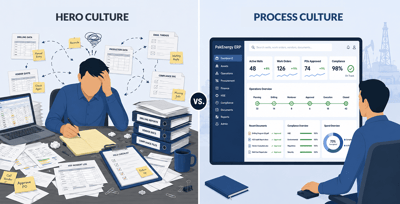 Hero culture develops when organizations become dependent on a handful of experienced employees who know how everything works. Need to understand an ownership exception? Ask Sarah. Need to reconcile a historical joint interest billing discrepancy? Call Mike. Need to determine why a lease obligation was extended five years ago? Talk to Jennifer. At first, this seems like a strength. Every organization benefits from knowledgeable employees who understand the business.
The challenge appears when those employees become the only reliable source of critical information. Knowledge becomes concentrated instead of distributed. Processes become personal instead of documented. Operational continuity depends on individuals rather than systems. For CFOs, that dependency creates risks that extend well beyond human resources. Financial reporting slows, audits become more difficult, onboarding takes longer, and acquisitions require extensive manual knowledge transfer because operational history cannot easily be reconstructed.
Process Culture Creates Organizational Resilience
Organizations become more resilient when critical knowledge is embedded within repeatable business processes instead of individual employees. That shift does not reduce the importance of experienced professionals. Quite the opposite. It allows their expertise to benefit the entire organization instead of remaining locked inside personal files, spreadsheets, or institutional memory. Process culture begins with documentation, but it does not end there.
- Reliable workflows
- Standardized approvals
- Consistent data entry
- Connected operational records
- Documented ownership history
- Centralized reporting
Each improvement makes the organization less dependent on a single individual while making operational knowledge more accessible to everyone else. This becomes particularly valuable during acquisitions, internal promotions, and succession planning. New employees inherit established processes instead of trying to recreate them from conversations with colleagues.
Why ERP Systems Have Become Knowledge Platforms
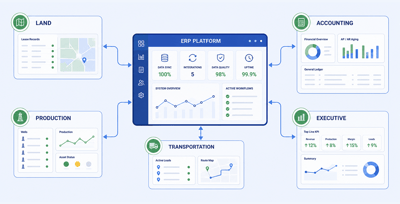
Today, ERP systems serve a broad purpose not just connecting disparate systems but communicating knowledge. A modern upstream ERP software platform connects financial information with operational workflows across multiple departments. Land records, production reporting, accounting transactions, owner relations, transportation activity, and supporting documentation can all contribute to a more complete operational picture.
For CFOs, that connectivity provides value beyond efficiency. It creates organizational memory. Instead of relying on individual employees to explain historical decisions, organizations can maintain documented approval workflows, transaction histories, supporting documents, and operational records that remain accessible long after projects have been completed. That continuity strengthens financial reporting while also reducing the risk associated with employee turnover.
Where Tribal Knowledge Usually Hides
One of the biggest misconceptions about institutional knowledge is that it exists only in people's memories. Much of it actually exists in disconnected places throughout the organization.
- Historical spreadsheets
- Personal notebooks
- Email folders
- Shared network drives
- Desktop files
- Paper binders
- Legacy databases
Individually, none of these resources seem particularly problematic. Together, however, they create an environment where finding reliable information becomes increasingly difficult. Two employees may maintain different versions of the same report. Critical lease correspondence may exist only in archived emails. Historical accounting decisions may depend on spreadsheets that no longer have clear ownership. The issue is rarely missing information. The issue is knowing which information should be trusted.
Connecting Information Across the Business
Institutional knowledge becomes significantly more valuable when departments are no longer operating independently. Consider how information flows through a typical oil and gas organization.
Production teams generate operational data every day. Accounting relies on that information for financial reporting and revenue distribution. Land departments maintain ownership records that affect both operational planning and financial obligations. Transportation teams contribute ticketing, logistics, and field activity that supports billing and operational visibility.
Viewed individually, each department maintains its own records and follows its own workflows. When those systems remain disconnected, valuable operational context can be lost as information moves from one team to another. Organizations that connect those workflows through integrated business systems create something much more valuable than operational efficiency. They create a shared knowledge base that allows departments to understand not only what happened, but why it happened and how similar decisions should be handled in the future.
A Realistic Executive Scenario
Consider a mid-sized upstream operator preparing for the retirement of a controller who has spent more than thirty years with the company. During that time, they became the unofficial expert on everything from joint interest billing exceptions and owner revenue adjustments to historical acquisitions and legacy accounting practices. Whenever a question surfaced, someone simply walked into their office. After the retirement announcement, leadership begins documenting responsibilities. What they expect to be a straightforward transition quickly becomes something much larger.
Critical spreadsheets have evolved over decades without formal documentation. Approval workflows differ depending on the type of transaction. Certain reconciliations are performed because of historical agreements that newer employees have never seen. Much of the reasoning behind those decisions exists only in conversations, handwritten notes, or personal email folders. None of this reflects poor management. It reflects the reality of how many organizations have grown over time.
Fortunately, the company has already begun centralizing its financial records, workflows, and supporting documentation within an integrated ERP environment. While no software can replace decades of professional experience, it can preserve the records, approvals, supporting documentation, and operational context that future employees will need to understand how the business operates. The transition still requires planning and knowledge transfer, but it becomes a manageable process instead of a scramble to reconstruct years of institutional memory.
Why Standardized Workflows Strengthen Financial Performance
 When organizations discuss process improvements, conversations often focus on efficiency. For CFOs, the benefits extend much further. Standardized workflows improve consistency throughout the organization. Approvals follow established paths instead of relying on informal practices. Supporting documentation remains connected to the transactions it explains. Financial reports are built from consistent operational data rather than multiple versions maintained by different departments. These improvements strengthen financial reporting in several important ways.
Month-end close processes become more predictable because employees follow documented procedures instead of relying on institutional memory. Audit preparation becomes less disruptive because supporting records are organized and easier to retrieve. Internal controls become more consistent because approval workflows are embedded within business processes rather than dependent on individual judgment. Perhaps most importantly, new employees become productive more quickly because they inherit established processes instead of trying to decipher years of undocumented practices. The goal is not to eliminate professional expertise. It is to create an environment where expertise is shared, documented, and reinforced through repeatable processes.
Supporting Growth Without Losing Knowledge
Growth creates opportunities, but it also places additional pressure on organizational knowledge. New acquisitions introduce unfamiliar assets, historical accounting records, ownership structures, and operational workflows. Expanding into new regions brings additional regulatory requirements, business partners, and reporting obligations. As organizations grow, the number of people who need access to accurate information grows as well. If institutional knowledge remains concentrated among a few experienced employees, every acquisition increases organizational risk.
By contrast, organizations that document workflows and centralize operational information are better prepared to integrate new assets because established processes already exist. New employees can learn from documented procedures instead of depending entirely on verbal instruction, and leadership gains greater confidence that critical business practices will remain consistent across the organization.
This is one reason many energy companies view digital transformation as a long-term business strategy rather than simply a technology initiative. The objective is not only to improve today's operations. It is to ensure the organization can continue operating effectively as people, assets, and business priorities change.
Technology Supports Knowledge. People Create It.
It is tempting to think of technology as the solution to institutional knowledge challenges. In reality, technology provides the framework. People provide the expertise. Experienced professionals understand why certain accounting treatments were applied, how ownership evolved over time, and what operational considerations influenced previous decisions. Those insights remain invaluable.
The role of an ERP platform is to help organizations preserve the information surrounding those decisions through documented workflows, connected records, approval histories, and centralized documentation. Future employees still benefit from experienced mentors, but they also have access to the records and context needed to continue those processes with confidence.
PakEnergy's oil and gas accounting software, land management software, production reporting software, and PakEnergy Intelligence platform help organizations centralize operational and financial information across multiple departments. Publicly available product information emphasizes connected workflows, document management, reporting, and operational visibility that support long-term business continuity. These platforms are designed to improve information accessibility and process consistency rather than replace the expertise of experienced employees.
Practical Steps CFOs Can Take This Quarter
Organizations do not preserve institutional knowledge overnight. The most successful initiatives usually begin with practical improvements that build momentum over time. Start by identifying processes that rely heavily on one or two experienced employees. Ask where critical information exists only in personal spreadsheets, email folders, or individual notebooks.
Next, review recurring financial workflows. Month-end close activities, revenue distributions, owner payments, approval processes, and reconciliations often reveal opportunities to improve documentation and standardization. Evaluate whether supporting documentation is connected to the transactions it explains. Financial records become significantly more valuable when approvals, attachments, and historical context remain available within the same workflow.
Encourage cross-functional collaboration between accounting, land, production, transportation, and operations teams. Institutional knowledge rarely belongs to a single department. Connecting information across the business helps preserve context that individual systems cannot provide on their own.
Finally, view succession planning as an ongoing operational discipline rather than a one-time project. Every documented workflow, centralized record, and standardized approval process strengthens the organization's ability to adapt as employees retire, change roles, or join the company.
The Bottom Line
Every energy company depends on experienced professionals whose knowledge has been built over decades of solving complex operational and financial challenges. That expertise represents one of the organization's greatest competitive advantages. It also represents one of its greatest vulnerabilities when that knowledge remains undocumented.
CFOs have an opportunity to change that trajectory by creating organizations where critical information is preserved through connected systems, standardized workflows, and documented business processes. Doing so reduces operational risk, improves continuity, strengthens financial reporting, and creates a more resilient business prepared for future growth.
Technology does not replace institutional knowledge. It helps ensure that institutional knowledge continues creating value long after individual employees have moved on.
Discover how PakEnergy's PakEnergy's oil and gas software solutions help energy companies centralize operational knowledge, connect business workflows, and strengthen long-term organizational resilience. By creating a more connected information environment, organizations can preserve valuable expertise while preparing for the next generation of growth.
FAQs
What is institutional knowledge management?
Institutional knowledge management is the process of capturing, organizing, and preserving the operational knowledge, business processes, and historical information that employees develop over time so it remains available to the organization.
Why is institutional knowledge important in oil and gas?
Oil and gas organizations often manage complex assets, ownership structures, regulatory requirements, and financial processes that develop over many years. Preserving that knowledge helps reduce operational risk and supports business continuity.
What is hero culture?
Hero culture describes an environment where critical business knowledge depends on a small number of experienced employees rather than documented processes and connected business systems.
How does an ERP support knowledge transfer?
An ERP helps centralize financial records, operational workflows, approvals, supporting documentation, and reporting so organizations can preserve business processes beyond individual employees.
How does process culture improve financial performance?
Documented workflows improve consistency, reduce manual errors, strengthen internal controls, simplify audits, and help organizations onboard new employees more efficiently.
How can CFOs prepare for workforce transitions?
CFOs can begin by identifying knowledge concentrated within individual employees, documenting recurring workflows, centralizing business records, and encouraging collaboration across departments so operational knowledge becomes part of the organization rather than remaining with specific individuals.
Sources & Additional Information
- U.S. Bureau of Labor Statistics - U.S. Department of Labor https://www.bls.gov