Webinar - Introducing OnPing Plunger - Powered by Pak AI | Oct 29
Oil and gas logistics is not forgiving. When a load slips, it rarely slips quietly.
A late truck can mean a crew waiting on a pad. A missed pickup can turn into a domino effect across your day. A ticket that goes missing can delay billing, spark disputes, and drag cash flow longer than it should.
And if you are still running dispatch out of spreadsheets, whiteboards, group texts, and a stack of paper tickets, you already know the feeling. It works until it doesn’t. Then your team spends the afternoon doing damage control instead of moving product.
That’s why more transportation and logistics managers in oil and gas are making the shift to a modern Transportation Management System (TMS). Not because it is trendy. Because the cost of manual dispatching adds up in hours, mistakes, detention, compliance exposure, and lost revenue, you cannot easily see on a single report.
Below is a practical breakdown of what manual dispatching is really costing you, what a modern TMS changes, and how to roll it out without disrupting your operation.
Hook + problem framing: “Manual” is rarely just manual
Most dispatch teams don’t choose manual processes. They inherit them.
You start with what is available. A spreadsheet for loads. A shared drive for documents. A dispatcher’s notebook full of tribal knowledge. A routine that depends on a few key people who “just know” what to do.
Over time, the operation gets more complex:
- More trucks, more drivers, more customers
- More products and delivery sites
- More rules to follow, more documentation to maintain
- More change requests and last-minute reroutes
Manual dispatching doesn’t break because your team isn’t capable. It breaks because the pace of the work outgrows the tools.
What Manual Dispatching Costs You
Time that disappears into coordination work.
Manual dispatching turns small tasks into recurring time drains:
- Calling drivers for updates
- Tracking who is available and where they are
- Rebuilding the “real schedule” after a change
- Searching for the latest ticket or the correct rate=
This is the kind of work that feels necessary but produces no forward momentum. It is overhead. And it expands as volume expands.
PakEnergy’s transportation blog posts consistently call out this exact pattern: phone tag, paperwork chasing, and delays caused by disconnected tools.
Errors That Turn Into Rework and Revenue Leakage
Manual processes create predictable mistakes:
- Wrong pickup or delivery details
- Incorrect rates
- Mismatched tickets/li>
- Loads assigned to the wrong driver or equipment type
- Missing fields that back-office teams need to invoice cleanly
Some errors are obvious. Many are quiet. They show up later as:
- Billing disputes
- Credit memos
- Re-issued invoices
- Back-and-forth that delays payment
A TMS doesn’t eliminate mistakes entirely, but it reduces “re-keying” and keeps the load record consistent from dispatch through ticket approval and invoicing. That directly cuts rework.
Detention and Dead Time That You Can’t Measure Well
In bulk commodity hauling, detention is not uncommon. It is part of the environment.
But manual dispatching makes detention harder to see and harder to manage because:
- Arrival and departure timestamps are inconsistent
- Proof is scattered across texts, calls, and paper
- Root causes are difficult to isolate (site delays, staging issues, miscommunication)
Even when your team knows detention is happening, it can be hard to quantify consistently enough to improve it. Without clean time data, you can’t reliably answer:
- Which sites cause the most delays?
- Which routes or shifts get hit hardest?
- Which customers create repeat friction?
Detention becomes “normal,” and normal becomes expensive.
Compliance Risk That Shows Up At The Worst Time
In regulated hauling, compliance is not just an audit concern. It affects daily planning.
Two common pressure points for oil and gas transportation are:
- Hours of Service (HOS): the rules that limit driving time and require rest periods FMCSA
- Electronic Logging Devices (ELDs): rules governing digital records of duty status and how they are captured and produced when requested FMCSA
When dispatch is manual, HOS constraints are easier to miss in the moment. Dispatchers may be working from partial information, especially when a schedule changes mid-day.
A modern TMS helps by making availability and constraints visible inside the dispatch workflow, so decisions are made with the same compliance picture every time.
For reference on these rules, FMCSA maintains official guidance onHours of Service (HOS) and General information about the ELD rule
Poor Visibility That Leads to "Late Surprises"
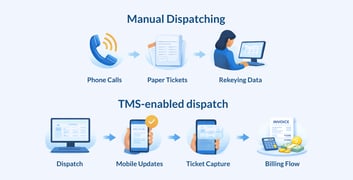
Manual dispatching reduces your ability to see the operation as it is happening.
Instead, you get:
- Delayed updates
- Partial updates
- Updates that rely on someone noticing and calling it in
That makes it harder to:
- Catch issues early
- Re-route efficiently
- Communicate accurate ETAs
- Keep customers informed without overloading dispatchers
PakEnergy’s transportation posts repeatedly emphasize that “real-time visibility” is not a nice-to-have. It is what prevents missed loads and keeps teams aligned.
What a Modern TMS Changes
A modern TMS is not just "dispatch software." It’s a connected workflow that ties together dispatch, driver updates, ticketing, approvals, billing, and reporting. Here’s what those changes mean in real terms.
Automation That Reduces Manual Touch Points
The biggest win is not flashy features. It’s fewer handoffs. TMS can centralize the load record so details don’t get re-entered multiple times. That means fewer chances to introduce errors, and less time spent cleaning up after them. PakEnergy describes this as “load creation to invoice,” in which ticket data and approvals are linked directly to billing.
Real Time Visibility That Supports Better Decisions
When the system captures live status updates and timestamps, dispatchers stop guessing.
Instead of "Where are you and how much longer?" You get:
- A visible load status
- Updated ETAs
- Driver availability and constraints
- A clearer view of exceptions that need attention
PakEnergy’s blog content consistently frames this as “live visibility across the fleet,” especially for scheduling and downtime reduction.
Carrier and Driver Performance You Can Actually Manage
Most teams have opinions about performance. A modern TMS gives you data to back it up.
You can track patterns like:
- On-time performance by customer or lane
- Detention patterns by site
- Repeat exceptions and their root causes
- Ticket turnaround time and approval speed
That unlocks practical improvements. Not theory.
Analytics That Turn Daily Chaos Into Operational Leverage
A TMS doesn't just record what happened. It helps you learn faster.
If you can measure:
- Empty miles
- Idle time
- Ticket cycle time
- Repeat route changes
- Exceptions by customer and site
You can improve margins without asking your team to “work harder”. You tighten the process instead.
PakEnergy’s transportation posts lean heavily on this theme: better data leads to smarter scheduling, fewer missed loads, and less chaos.
A Short Scenario
It’s 2:15 p.m. A dispatcher gets a call. A site pushed the delivery window forward, but one driver is already close to their HOS limit. Another driver is available, but their last ticket is still sitting in a stack waiting to be scanned.
The dispatcher makes a judgment call. They shuffle the schedule in a spreadsheet, text two drivers, call the site contact, and hope the updated plan sticks.
Then the day gets worse:
- The original driver gets stuck at the site waiting to unload
- A ticket detail is missing, so billing can’t close the load
- The customer asks for an ETA update, and the dispatcher starts calling drivers again
Nothing catastrophic happened. But three hours disappeared. The team carried unnecessary stress. And the business just took on an avoidable cost.
A modern TMS doesn’t prevent every disruption, but it reduces the “coordination tax” that turns normal changes into expensive chaos.
Adoption Roadmap: Practical Steps That Don't Disrupt The Operation
A TMS rollout is successful when it is treated as an operational workflow upgrade, not a software installation.
1. Start with one workflow that is visibly painful
Pick a slice where the ROI is easy to feel:
- Dispatching and load assignment
- Ticket capture and approval
- Load-to-invoice cycle time
- Visibility and exception management
Avoid trying to fix everything at once. Momentum matters.
2. Define your "source of truth" and stick to it
If your team continues to run the real schedule in a spreadsheet "just in case," adoption stalls.
Agree on:
- Where loads are created
- Where updates happen
- Where tickets live
- Where billing pulls from
One system. One record.
3. Make drivers' lives easier first

Driver adoption is not about training manuals. It’s about reducing friction.
If drivers can:
- See assignments clearly
- Update status quickly
- Submit tickets without hassle
- Get drivers paid faster
- Maintain compliance effectively
PakEnergy's transportation content emphasizes mobile-friendly workflows and real-time updates as a key advantage for field teams. In an environment where driver turnover is a constant challenge, this can be a tremendous benefit for operators.
4. Build a simple exception playbook
A TMS works best when it highlights what needs attention.
Define:
- What counts as an exception
- Who owns it
- What "resolved" looks like
This keeps dispatchers from drowning in noise.
5. Measure a few outcomes that matter to logistics managers
Don't overcomplicate metrics. Pick 3-5 that tie to revenue and efficiency.
- Ticket turnaround time
- Detention time consistency and trend
- Empty miles trend (or loaded mile ratio)
- Billing cycle time (load completion to invoice)
- Missed loads or late loads count
When the operation sees improvement, buy-in grows naturally.
Conclusion
Manual dispatching doesn't just slow down your day. It limits how efficiently you can grow.
It pulls dispatchers into constant coordination work. It makes tickets harder to manage. It increases the odds of billing delays and disputes. And it makes it difficult to get a clean picture of what is actually happening across the fleet.
A modern TMS changes that by connecting the workflow end-to-end, from dispatch to ticketing to billing, with real-time visibility that helps you prevent issues instead of chasing them.
If you are evaluating next steps, start with one question: Where are we losing the most time and money today because information is late, scattered, or re-entered?
If you want to see what an oil and gas-ready TMS workflow looks like, PakEnergy’s Transportation resources and blog posts are a good place to start, especially around mobile dispatching and load-to-invoice workflows.
Sources
Linked references:
- ONRR production reporting resources (onrr.gov/reporting/production)
- CISA #StopRansomware Guide (cisa.gov/stopransomware/ransomware-guide)
Additional references:
- ONRR Form ONRR-4054-A (OGOR-A) instructions (Office of Natural Resources Revenue, rev. 5/2019)
- CISA “Cybersecurity Best Practices for Industrial Control Systems” publication (revision date Dec. 17, 2020)
- NIST Special Publication 800-82 Rev. 2, Guide to Industrial Control Systems (ICS) Security (National Institute of Standards and Technology)