Webinar - Introducing OnPing Plunger - Powered by Pak AI | Oct 29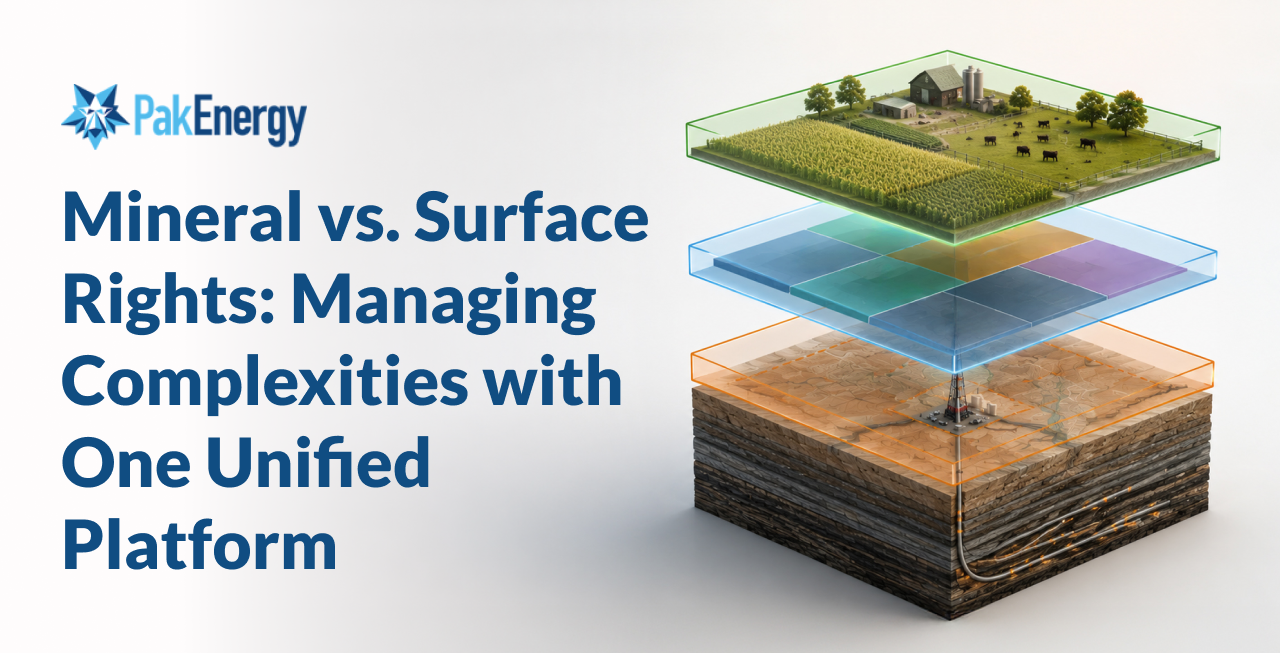
In the world of land management and owner relations, no two days are exactly alike. One afternoon, you may be untangling a century-old chain of title involving dozens of heirs, and the next, you are navigating a delicate negotiation with a surface owner regarding a new drill site location. The fundamental challenge of our industry is that the ground beneath our feet is rarely as simple as it appears on a map.
 As we move through 2026, the density of data and the pace of operations have only increased. Teams are juggling split estates, legacy records that may be incomplete, and a constant stream of ownership changes that must be reflected in real-time. When land data is fragmented across multiple spreadsheets or siloed legacy systems, the risk of missed obligations or incorrect royalty payments increases.
Managing the interplay between mineral and surface rights requires more than just industry expertise; it requires a digital foundation that can unify these disparate data points. A unified platform provides the clarity needed to protect your assets, satisfy your owners, and maintain a steady rhythm of production.
Understanding the Divided Estate: Minerals and Surface
To manage land effectively, one must first respect the "severance" of the estate. In many parts of the United States, it is common for the ownership of the surface of a property to be separated from the ownership of the minerals lying beneath it. When this occurs, it creates a split or severed estate.
Defining Key Terms in the Land Department
To keep everyone on the same page—from the field to the back office—it is helpful to define the core concepts that dictate our daily workflows:
- Mineral Rights: The ownership of the resources beneath the surface, including oil, gas, coal, and other valuable minerals.
- Surface Rights: The ownership of the surface level, which includes the right to farm, build structures, and graze livestock.
- Split Estate: A situation where different parties own the surface and mineral estates. This is a common discovery during title research in prolific basins.
- Tract: A defined parcel of land. A single tract may have one surface owner but dozens of mineral owners.
- Lease: The legal agreement where a mineral owner grants an operator the right to explore for and produce resources in exchange for consideration, such as a bonus or royalty.
- Right of Ingress and Egress: A general concept in many jurisdictions where the mineral estate is considered "dominant," meaning the mineral owner (or their lessee) has a right to use as much of the surface as is reasonably necessary to develop the minerals.
- Surface Use Agreement (SUA): A contract between an operator and a surface owner that defines how the surface will be used, how damages will be compensated, and where infrastructure like roads or pipelines will be placed.
- Division Order: A document that directs the operator on how to distribute proceeds from production to various interest holders based on the ownership percentages confirmed by a title opinion.
Whenever land changes hands, the ownership can be split further. Mineral rights refer to ownership of the resources beneath the property, while surface rights pertain to ownership of the surface level. Landowners can sell their surface rights while retaining their minerals, or sell a portion of their minerals to a third party.
The Practical Complexities of Modern Landwork
If every project involved a single owner of both the surface and the minerals (known as "fee simple" ownership), land management would be straightforward. However, the reality is far more complex.
Chain of Title and Ownership Updates
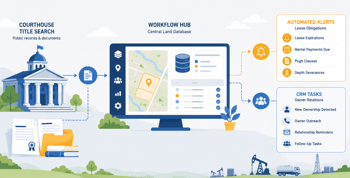 Confirming ownership is a constant exercise in landwork. Land teams must trace the chain of title through decades of deeds, wills, and conveyances. A single missing link can lead to a title gap that stalls a project. In 2026, the volume of data generated during these searches is immense. If that data is not captured in a central database, the "tribal knowledge" of who owns what can easily be lost when a key landman retires or moves on.
Conflicting Records and Spreadsheet Chaos
Many companies still rely on a patchwork of legacy systems and standalone spreadsheets to track their assets. This creates "data silos." The land department might have one lease version in their folder, while the accounting team has a different set of owner percentages in their ERP. When these systems don't talk to each other, the result is rework, payment exceptions, and a loss of trust with owners.
Surface Restrictions and Communication
Surface owners who do not own the minerals often believe they have the exclusive right to use and enjoy the land. Until mineral activity commences, they may not realize what separate ownership of the mineral rights means. Managing this tension requires proactive communication and meticulous recordkeeping. Every phone call, email, and meeting with a surface owner should be logged to ensure that the operator is honoring the "accommodation doctrine"—the principle that mineral development should reasonably accommodate existing surface uses.
Linking Documents to the Correct Tract
A single surface agreement might cover multiple tracts, or a single mineral lease might only cover a small fraction of a large ranch. Manually linking these documents to the correct GIS polygons and owner profiles is a recipe for error. A modern platform automates this linking, ensuring that when you click a tract on the map, you instantly see every agreement and owner associated with that specific tract.
How a Unified Platform Reduces Operational Risk
The goal of a unified platform is not to replace the land professional; it is to empower them. By consolidating your data into a single source of truth, you move from a reactive posture to a proactive one.
A Single Source of Truth
When the tract, lease, owner, and document relationships are housed in a single system, everyone in the organization sees the same numbers. If an ownership update is made in the land database, it should flow directly into your land management software and inform the division order process. This integration eliminates the "manual re-keying" that is the primary source of data drift in our industry.
Version Control and Audit Trails
In an era of heightened regulatory scrutiny, proving when a change was made and who approved it is essential. A unified platform provides an unalterable audit trail for every edit to a lease or a surface agreement. This "transparency by design" satisfies internal auditors and provides a secure foundation for SOX compliance.
Streamlined Workflow Routing
Landwork is a team sport. A new lease must be reviewed by legal, approved by management, and then set up in accounting for payment. A unified platform uses automated workflows to route these tasks to the right person at the right time. This replaces the "follow-up email" and ensures that no lease bonus or surface damage payment falls through the cracks.
Standardized Fields and Validation
Human error is the most expensive line item on many budgets. By using standardized fields and data validation, such as ensuring a legal description follows a consistent format, you reduce the risk of downstream exceptions. When the data is clean at the point of entry, the reports generated for leadership and accounting are inherently more trustworthy.
Realistic Scenarios in Land and Owner Relations
To illustrate the value of a unified approach, let's look at two scenarios that land teams face every day.
Scenario 1: The Surface Agreement Standoff
An operator is preparing to build a new road to a planned wellsite. The land team has a Surface Use Agreement (SUA) on file, but it was signed by a previous surface owner three years ago. The new surface owner is claiming the agreement is invalid and is blocking access.
In a manual system, the landman might spend hours digging through paper files or searching for an email from the previous owner's attorney. In a unified platform, the landman can instantly pull up the recorded SUA, the map showing the agreed-upon route, and the history of payments made to the previous owner. Having this data at their fingertips allows for a calm, authoritative conversation that can resolve the standoff in minutes rather than days.
Scenario 2: The Multi-Heir Probate Puzzle
A long-time mineral owner passes away, leaving their interest to six children spread across four states. Two of the children have already sold their interests to a mineral acquisition company, while another is disputing the will.
The owner relations team is flooded with calls and emails. In a fragmented system, the team might accidentally pay the deceased owner's estate or miss an update to a division order, leading to a suspense issue. With a unified platform, the team can log every inquiry in an owner relations CRM, track probate documents as they arrive, and update ownership percentages once curative work is complete. The division order is updated, ensuring that the first check after production is sent to the right people at the right address.
The Role of GIS in Unifying Land Data
Geographic Information Systems (GIS) are the "visual glue" that holds a unified platform together. We are visual people; we want to see the land. A modern platform allows for digital overlays.
This visual context is invaluable for identifying "open acreage" and spotting potential surface-use conflicts before the rig moves on site. When your GIS is integrated with your land database, a change in a lease status—from "Active" to "Expired"—is immediately reflected on the map. This real-time visibility enables a lean team to manage a large, complex portfolio with confidence.
Conclusion: Securing Your Assets and Your Reputation
The complexities of managing mineral and surface rights will only continue to grow. As basins become more crowded and ownership becomes more fragmented, the margin for error shrinks. A "good enough" manual process is no longer sufficient to protect your company's interests or your reputation with owners.
Transitioning to a unified platform is an investment in the long-term health of your operation. It provides the "Single Source of Truth" to eliminate data silos, automated workflows to prevent missed deadlines, and reporting that gives leadership the confidence to make informed decisions.
At PakEnergy, we understand that landwork is the engine that drives our industry. Our goal is to provide the digital infrastructure that lets you spend less time wrestling with data and more time creating value. "The Pak has your back" means we are committed to providing the steady, reliable tools you need to manage the complexities of the divided estate.
Ready to Modernize Your Land Department?
Discover how our land management software can unify your data and streamline your workflows. Whether you are managing a handful of wells or a multi-basin portfolio, we have the tools to help you work smarter and stay ahead of the curve. Reach out today for a practical conversation about your digital future.
Sources
- Earthworks Split Estate: Definition and Ownership Severance https://earthworks.org/issues/split_estate/
- Law Archive of Wyoming Scholarship Split Estate: Communication and Education versus Legislation https://scholarship.law.uwyo.edu/cgi/viewcontent.cgi?article=1088&context=wlr
- U.S. Department of the Interior - Bureau of Land Management (BLM): Oil and Gas Management and Split Estate Rights https://www.blm.gov/programs/energy-and-minerals/oil-and-gas/about