Webinar - Introducing OnPing Plunger - Powered by Pak AI | Oct 29
For years, spreadsheets carried the weight of oil and gas accounting. They’re easy to open, familiar to every accountant, and usually the first place a CFO or controller starts. But what worked when the business was smaller quickly becomes a liability that multiplies as reporting piles up, and regulators raise the bar.
Instead of helping, those endless rows of numbers begin to slow teams down. Mistakes slip in, audits get harder, and opportunities are missed while leadership waits for the books to close. That’s why more finance leaders are shifting to oil and gas accounting software in the cloud, tools that give them speed, accuracy, and peace of mind, while competitors are still buried in manual entry.
The Hidden Risks of Relying on Spreadsheets
Human Error and Audit Exposure
Anyone who’s lived in spreadsheets knows the feeling; they behave until they don’t. Maybe someone rushes an entry, a decimal wanders into the wrong box, or a formula refuses to copy the way you thought it did. Next thing you know, the totals are off and nobody can figure out why. The difference isn’t pocket change either; it can be thousands, and the whole team is left tearing through cells trying to spot the slip. And by the time anyone notices, it’s usually at the worst possible moment. In an industry where joint interest billing (JIB), royalty payments, and tax filings must be precise, these errors can result in serious audit headaches.
Limited Scalability
 Spreadsheets can’t grow with your business. As your company takes on new wells, partners, and reporting obligations, the number of tabs and files multiplies. Instead of supporting growth, spreadsheets create bottlenecks that slow the close process and frustrate staff.
Lost Revenue Opportunities
When reporting takes weeks, leadership decisions lag behind reality. When the numbers don’t come in until weeks later, CFOs are left making decisions in the dark. That delay can mean missed chances to cut costs, failure to react to a shift in the market, or move quickly on an acquisition. In other words, if the data drags, the strategy drags with it.
Why Cloud-Based Accounting is the Smarter Choice
Compliance Confidence
Petroleum accounting software designed for the energy industry simplifies compliance with 1099s, ONRR 2014, JIB distributions, escheatment, and revenue allocations. Instead of scrambling to patch together reports at year-end, controllers can generate accurate, audit-ready outputs with a few clicks.
Real-Time Visibility Across Entities
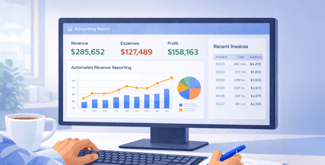
With a true upstream ERP, financial leaders gain a consolidated, accurate view of their operations. Whether managing multiple entities or preparing for investor reporting, modern platforms deliver dashboards and analytics instantly, eliminating the need for emailing spreadsheets back and forth.
Security and Accessibility
Unlike unsecured files saved on desktops or shared drives, cloud platforms safeguard sensitive data with encryption and access controls. At the same time, teams can work from anywhere, headquarters, field offices, or at home without losing productivity.
The Competitive Edge of Early Adopters
Some operators are already reaping the rewards. By automating JIB processes and owner revenue distributions, early adopters are cutting close times from weeks to days. Controllers who once spent late nights reconciling spreadsheets now trust the system to handle calculations.
- Efficiency gains: fewer manual hours spent re-keying numbers.
- Stronger partnerships: owners and partners are paid faster and more accurately.
- Growth readiness: companies can take on acquisitions without fear that their systems will break under the weight.
Meanwhile, laggards remain stuck in “spreadsheet hell,” exposing themselves to both financial and reputational risks.
How to Transition Smoothly (Without Disruption)
 Many CFOs hesitate to move off spreadsheets because they fear disruption. But modern oil and gas accounting software is designed for smooth adoption. Migration teams map data, clean duplicates, and ensure continuity of reporting. Staff receive training tailored to their roles, and support doesn’t stop after go-live.
Instead of ripping and replacing overnight, implementation is phased and collaborative, reducing resistance and setting teams up for long-term success.
The Cost of Waiting Another Quarter
Every month spent relying on spreadsheets increases risk:
- Another close cycle where errors can slip through.
- Another audit where documentation takes weeks to prepare.
- Another opportunity missed because decision-making lagged.
In competitive energy markets, delay has a price tag. Moving to the cloud isn’t just about efficiency; it’s about protecting margins, scaling confidently, and winning investor trust.
Spreadsheets may have built the foundation of energy accounting, but they can’t carry operators into the future. The leaders who embrace cloud-based oil and gas accounting software today are gaining efficiency, compliance assurance, and a stronger competitive position.
For CFOs and controllers, the choice is clear: stay stuck in error-prone spreadsheets, or modernize with petroleum accounting software that delivers real-time visibility and long-term scalability.
Ready to see how PakEnergy’s upstream ERP transforms accounting? Book a demo with a PakPro today! Or, explore our eBooks and webinars to learn how oilfield leaders are using technology to stay ahead.