Webinar - Introducing OnPing Plunger - Powered by Pak AI | Oct 29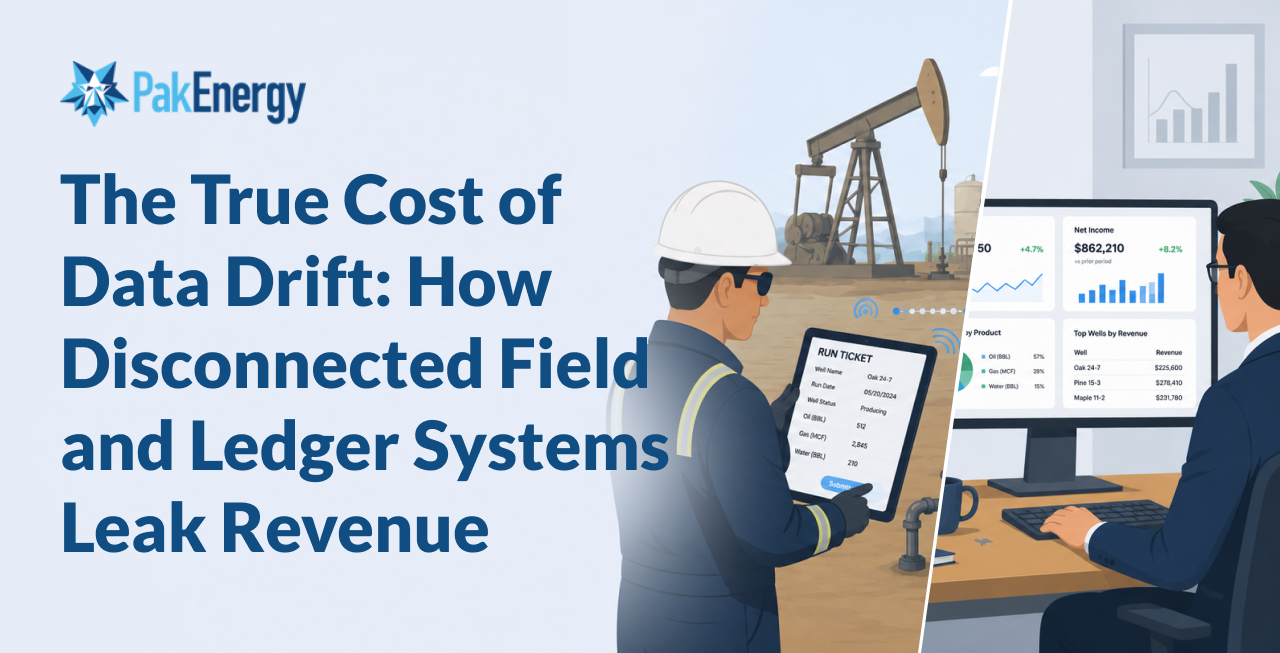
Oil and gas companies generate critical financial information long before anything reaches the general ledger. It starts in the field, where production volumes are captured, tickets are created, downtime is documented, and operating activity begins to shape the financial picture of each well.
The trouble starts when that information takes a winding route to accounting. A run ticket may be entered in one system, production data may live somewhere else, and supporting notes may arrive by email or spreadsheet. By the time the controller sees the final numbers, the data may have been rekeyed, reformatted, or adjusted several times. Nothing has necessarily gone dramatically wrong, but small differences can creep in at every handoff. That is data drift.
For CFOs and Controllers, the cost is rarely limited to a few extra minutes of reconciliation. Disconnected field and ledger systems can create mismatched volumes, delayed financial reporting, duplicate work, and questions that take longer to answer than they should. When teams cannot easily trace a number back to its operational source, confidence in the financial picture starts to erode.
A connected oil and gas software environment can give field and office teams a more consistent path for operational data to move through the business. PakEnergy's upstream platform connects production and accounting workflows, helping reduce the number of manual handoffs between field activity and the financial records that accounting teams ultimately review. The goal is not perfect data. It is fewer opportunities for information to drift as it moves from the wellsite toward the ledger.
What Is Data Drift in Oil and Gas Accounting?
Data drift occurs when operational information changes, loses context, or falls out of sync as it moves between systems, spreadsheets, and departments. In upstream operations, that can happen surprisingly easily. Field teams capture production volumes or run ticket details. Office personnel review and adjust those records. Accounting receives information later in the cycle and compares it against purchaser statements, revenue records, or financial reports. If those processes rely on separate systems, each handoff becomes another point where timing, formatting, or manual entry can introduce differences.
The issue is not always an obvious error. More often, it is a collection of small discrepancies that forces accountants to stop and investigate. Why does this ticket volume differ from the production report? Was an adjustment already entered somewhere else? Which value is the final approved number? Did accounting receive the corrected field information? Those questions are familiar because they sit right at the intersection of operations and finance.
Why Manual Handoffs Create Financial Risk
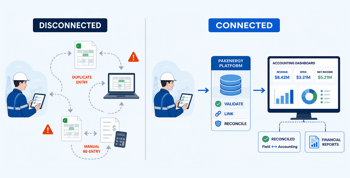 Manual processes are not automatically inaccurate. Plenty of experienced oil and gas accountants have kept complex businesses running with spreadsheets, emailed reports, and carefully maintained reconciliations. The problem is scale.
As well counts, transaction volumes, ownership structures, and reporting demands increase, the number of handoffs increases too. A workflow that once depended on one accountant checking one spreadsheet may eventually involve field operators, production staff, revenue accountants, controllers, and management. Every time information is reentered or manually reconciled, another control point is required.
That matters from a financial reporting perspective. SEC guidance on internal control over financial reporting discusses management's responsibility for evaluating internal control over financial reporting and the importance of an effective control environment.
For oil and gas finance teams, the practical implication is straightforward. The fewer times operational information has to be manually recreated on its way to accounting, the fewer unnecessary handoffs finance has to manage and investigate.
Where Revenue Accuracy Starts to Break Down
Revenue accuracy is not created at month-end. It depends in part on the quality and consistency of the operational information feeding the accounting process.
Consider a run ticket. The ticket represents a field event, but it can also become part of a financial workflow. Volume information may feed production reporting, be compared against purchaser information, and later help accounting teams investigate payments and revenue activity.
PakEnergy's upstream platform supports comparisons between check stub information and run tickets to help users verify order and payment information. Its production solution also supports run ticket management, field data capture, validation, and reporting. Connecting those records gives accounting teams a clearer path between financial information and the operating activity behind it. When that information remains disconnected, reconciliation can start to feel like detective work.
The Real Cost Is Often Rework, Not One Big Error
The phrase "revenue leakage" can sound dramatic, and it should be used carefully. Not every data mismatch translates directly into lost cash.
What disconnected systems can consistently create, however, is uncertainty.
An accountant has to investigate a volume difference. A production employee is asked to confirm an old ticket. A controller waits for a reconciliation before relying on a report. An adjustment gets pushed into the next cycle because the supporting information is not available yet.
None of those events may be financially material by itself. Together, they create a recurring cost in staff time, reporting delays, and reduced confidence in the numbers.
That is the quieter financial impact of data drift. The organization keeps functioning, but highly skilled employees spend part of every reporting cycle correcting or investigating information that could have moved through the business more cleanly in the first place.
How Connected Field and Accounting Workflows Change the Process
The goal of integration is not to remove financial controls. It is to give the people responsible for those controls better information.
When production information, field tickets, and accounting records are connected through shared workflows, accounting teams have more context available when something does not match. They can trace transactions more efficiently, compare operational and financial information, and spend less time reconstructing events after the fact.
PakEnergy's oil and gas accounting software supports specialized accounting workflows including general ledger, accounts receivable, accounts payable, JIB, revenue distribution, and check stub entry. PakEnergy also documents connections between its accounting environment and production and field operations.
That does not mean discrepancies disappear automatically. Financial teams still need reconciliations, approvals, and review. What changes is the amount of fragmented information they may have to assemble before those controls can do their job.
The U.S. Government Accountability Office's Standards for Internal Control in the Federal Government, commonly known as the "Green Book," provide another useful framework for thinking about reliable information and defined processes within a control environment. The Green Book applies to the federal government, so it is not a compliance standard for an oil and gas operator. Its broader principles, however, illustrate why the quality and flow of information matter when organizations design and operate controls.
When Production and Finance See the Same Story
The biggest advantage of connected systems is not that everyone uses the same dashboard. It is that different teams can work from records tied to the same underlying operational activity.
Production can focus on volumes, downtime, and field events. Accounting can focus on revenue, costs, allocations, and financial reporting. Leadership gets a clearer view of performance without waiting for several departments to reconcile competing versions of the same activity.
That shared foundation becomes especially valuable during close, when timing matters and small discrepancies tend to surface at exactly the wrong moment.
Instead of asking which spreadsheet is current, teams can spend their time understanding what changed and why.
A Controller's View of Data Drift
Consider a controller reviewing month-end revenue for an operator with producing properties spread across several fields. The accounting team notices that the volume associated with one property does not line up with the information they expected to see. It is not a glaring difference, but it is large enough that nobody wants to finalize the numbers without understanding what happened.
Finding the answer becomes the problem.
Accounting checks its records, then reaches out to production. Production reviews the field data and discovers that a ticket had been corrected after the original information was recorded. Now the teams have to determine which record reflects the final activity, whether the correction reached the appropriate downstream workflow, and whether anything else was affected.
This is a hypothetical scenario, but the underlying problem is familiar. A relatively small discrepancy can consume time across several departments when operational and financial records are difficult to trace back to the same source activity.
Connecting those workflows does not eliminate the need for reconciliation. It gives the people doing the reconciliation better context. Instead of rebuilding the history of a transaction from emails, spreadsheets, and separate records, teams can investigate exceptions with more of the supporting information already available.
For a controller, that distinction matters. The goal is not to eliminate review. It is to stop wasting review time reconstructing information the organization already captured somewhere else.
Why Data Drift Makes the Close Harder Than It Needs to Be
Month-end close has a way of exposing every weak handoff in a business.
During the month, a missing detail or delayed correction may not attract much attention. Once finance begins reconciling accounts and preparing reports, those loose ends start showing up together. A volume needs verification. A payment looks unusual compared with the previous month. A field correction has to be traced through accounting. Someone needs supporting documentation, and the person who has it is working on something else.
The accounting team becomes the cleanup crew for problems that often began well before the information reached the ledger.
Connected workflows can reduce that burden by making relevant operational information easier for financial teams to access. PakEnergy's Accounting platform, for example, includes check stub entry functionality with missing-payment reporting and variance analysis that compares receipts by property across different periods. The platform also supports general Ledger, accounts payable, accounts receivable, JIB, and revenue distribution.
That matters because better access to relevant information changes the nature of reconciliation. Accountants can spend more time investigating genuine exceptions and less time locating the records required to begin the investigation.
Revenue Reconciliation Needs Operational Context
A ledger tells finance what was recorded. It does not always explain what happened in the field.
That distinction becomes important when a revenue accountant encounters a discrepancy involving volumes, purchaser information, or payment activity. Understanding the financial entry may require operational context that originated days or weeks earlier.
Connected production and accounting data can shorten that distance.
PakEnergy Accounting’s robust functionality includes variance reporting for revenue receipts, missing-payment reporting, detailed revenue distribution records, and general ledger functionality. Its production solution supports field data capture, production surveillance, validation, and reporting.
For CFOs and Controllers, the benefit is not simply having more data. Most organizations already have plenty of it. The more important question is whether the information needed to investigate a financial exception can be found, understood, and traced without starting a scavenger hunt across departments. That is where integration begins to have practical financial value.
Better Integration Supports Better Controls
Automation sometimes gets framed as a way to remove people from a process. In accounting, that is usually the wrong goal. Controllers still need approvals. Revenue accountants still need to investigate unusual activity. Reconciliations still matter, and material financial information still deserves human review. A stronger system makes those controls easier to perform consistently.
When field and financial records are connected, the accounting team has a clearer trail to follow when something changes. Exceptions can be investigated with supporting operational context, while management retains the review and approval processes appropriate to the organization. There is an important distinction here. Integration is not itself an internal control framework, nor does implementing an ERP automatically make financial reporting accurate. Technology supports the control environment; management remains responsible for designing, operating, and evaluating the controls appropriate to the business.
For CFOs, that is a much more useful way to think about digital transformation. The question is not, "How much accounting work can we automate?" It is, "Where are people spending time compensating for disconnected information, and can the underlying process be improved?"
What CFOs Should Look for in a Field-to-Finance Workflow
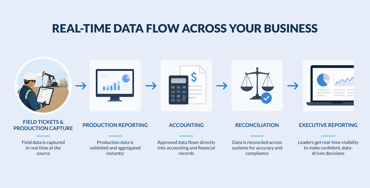 A useful assessment can begin with the places where accounting regularly has to leave its primary workflow to find an answer.
Look at the reconciliations that consistently require production input. Review the spreadsheets that exist because two systems do not exchange information cleanly. Pay attention to adjustments that repeatedly arrive late in the close cycle, along with reports that depend on someone manually combining information from several sources. Those workarounds are often more revealing than a software inventory.
For a CFO or Controller evaluating a more connected environment, several capabilities deserve attention:
- Traceability: Can the team follow financial information back to the supporting operational record?
- Validation: Are there controls that help identify incomplete or questionable data before it moves farther downstream?
- Exception visibility: Can accountants identify missing payments, unusual variances, or other discrepancies without manually comparing several files?
- Integration: Do production and accounting workflows exchange the information each team actually needs?
- Audit support: Can the organization retrieve supporting transaction history without reconstructing it manually?
- Reporting: Can leadership see financial and operational information with enough context to make a useful decision?
The answers will vary by operator. What matters is identifying where the organization is repeatedly paying people to bridge gaps between systems.
The Cost of Data Drift Compounds as the Business Grows
A disconnected workflow can remain manageable for years, particularly when the people running it know every shortcut. Then something changes.
The company acquires properties. Transaction volume rises. A longtime employee retires. The accounting team takes responsibility for more entities. Reporting requirements become more demanding, or leadership expects answers faster than the existing process can produce them. Processes that depended on memory and manual intervention become harder to scale because the complexity grows faster than the team's ability to compensate for it.
This is where the cost of data drift becomes strategic rather than administrative. A business preparing for growth does not only need enough people to process today's workload. It needs financial processes capable of absorbing tomorrow's activity without multiplying the number of manual handoffs at the same rate.
For CFOs evaluating systems during a period of growth or acquisition, field-to-finance integration belongs in that conversation. The condition of the data pipeline affects how quickly new activity can become reliable financial information.
From Reconciliation Burden to Financial Visibility
There will always be exceptions in oil and gas accounting. A connected system does not change that. What it can change is the amount of effort required to understand them.
PakEnergy's publicly documented platform brings together accounting and production capabilities, while its accounting modules provide tools for revenue entry, variance analysis, missing-payment reporting, revenue distribution, JIB, general ledger, and other specialized energy workflows. That combination gives finance teams a stronger foundation for connecting operational activity with the financial records they ultimately have to review.
For the CFO, the payoff is not a promise of flawless data or an instant close. It is something more practical: fewer unnecessary handoffs, better access to supporting information, and a clearer path from field activity to financial reporting. That is how organizations can begin reducing data drift without weakening the controls that protect the integrity of the books.
The Bottom Line
Disconnected systems rarely announce themselves as a major financial problem. They show up as another spreadsheet, another reconciliation, another request to production, or another adjustment that needs to be researched before close. Over time, those small interruptions add up.
Connecting field and accounting workflows gives CFOs and Controllers an opportunity to address the problem closer to its source. Instead of relying on finance to repeatedly repair gaps after information reaches the ledger, organizations can create a more consistent path for operational data to move into accounting, reconciliation, and reporting.
PakEnergy's approach is built around that connection between specialized energy workflows. For finance leaders, the value is straightforward: better context for reconciliation, less dependence on manual data movement, and financial information that is easier to trace back to the activity behind it.
Ready to Connect Field Activity with the Financial Picture?
See how PakEnergy connects specialized oil and gas accounting with production and operational workflows, helping finance teams reduce manual handoffs and gain clearer visibility from field activity through financial reporting. Schedule a PakEnergy demo.
FAQs
What is data drift in oil and gas accounting?
Data drift occurs when operational and financial information becomes inconsistent as it moves between field systems, spreadsheets, manual processes, and accounting records. Differences may result from timing, corrections, re-entry, or disconnected workflows, creating additional reconciliation work for finance teams.
How can disconnected field and accounting systems affect revenue reporting?
Disconnected systems can make it harder to compare production activity, run tickets, purchaser information, and financial records. When discrepancies occur, accounting teams may need to gather information from several sources before determining whether an adjustment is required.
Does integrating field and accounting data eliminate reconciliation?
No. Reconciliation remains an important accounting control. Integration can make reconciliation more efficient by giving finance teams better access to the operational records and transaction history needed to investigate differences.
How does PakEnergy connect production and accounting workflows?
PakEnergy documents integration between its accounting and production solutions. PakEnergy Production supports field data capture, production surveillance, validation, and reporting, while PakEnergy Accounting includes specialized financial workflows including general ledger, JIB, revenue distribution, check stub entry, accounts payable, and accounts receivable.
Can PakEnergy help identify missing purchaser payments or revenue variances?
Yes. PakEnergy's Check Stub Entry functionality includes Missing Payments reporting that tracks purchaser or operator payments, along with variance analysis that can compare receipts property by property across prior periods or selected date ranges.
Why does field-to-finance integration matter during growth or acquisitions?
As operations grow, disconnected workflows can require additional manual reconciliation and institutional knowledge to keep information aligned. A more connected data environment can help organizations absorb additional activity without relying on the same growth in manual data movement between operational and financial teams.
Sources & Additional Information
- Staff Statement on Management's Report on Internal Control Over Financial Reporting U.S. Securities and Exchange Commission - https://www.sec.gov/info/accountants/stafficreporting.htm
- The Green Book: Standards for Internal Control in the Federal Government U.S. Government Accountability Office - https://www.gao.gov/greenbook