Webinar - Introducing OnPing Plunger - Powered by Pak AI | Oct 29
The energy landscape is not just changing; it is expanding. For decades, the American land professional was synonymous with the oil patch. They were the ones acquiring mineral leases, scouring courthouses for chain of title, and managing the intricate dance of land negotiations. But today, a new frontier has emerged. Solar and wind developers are scouring the same maps, often standing on the very same acreage, looking for a different kind of resource.
As traditional Oil and Gas (O&G) operators diversify their portfolios, the land department is often the first team to feel the shift. Transitioning landwork from fossil fuels to renewables is not as simple as swapping a derrick for a turbine. It requires a fundamental pivot in how we think about surface rights, lease structures, and long-term asset management. If you are a land manager looking at a future in solar or wind, understanding the nuances of this transition is the difference between a successful project and a stranded asset.
The Shared DNA of Landwork
At a high level, the core mission of landwork remains constant. You must identify a viable project area, confirm who owns it, secure the legal right to use it, and manage the obligations that come with that right. Whether you are drilling a horizontal well or erecting a 300-foot wind turbine, the baseline is always a clean title and a solid contract.
Both industries rely heavily on Geographic Information Systems (GIS) to visualize constraints. They both require deep relationships with surface owners. Most importantly, both sectors are currently under immense pressure to modernize their back offices. The days of the "shoebox full of leases" are over. To compete in 2026, you need a digital foundation capable of handling the complexity of modern energy production.
The Divergent Paths: Surface vs. Mineral
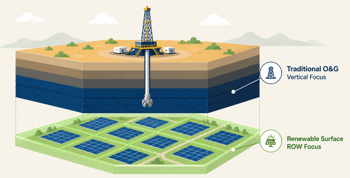 The most significant hurdle in transitioning from O&G to renewables is the shift from the mineral estate to the surface estate. In traditional oil and gas work, the mineral estate is typically dominant. If you own the minerals, you generally have a right to use as much of the surface as is reasonably necessary to extract them.
In solar and wind development, the surface is the primary asset. A solar farm might require 500 to 2,000 contiguous acres of relatively flat land with clear solar exposure. A wind project requires vast swaths of land for turbine placement and access roads. Unlike an oil well, which has a relatively small footprint after the initial drilling phase, a solar array occupies the entire surface for the duration of the project.
This changes the nature of the "Landman" role. You are no longer just tracing mineral deeds through three generations of heirs. You are now negotiating long-term surface leases, easements, and "good neighbor" agreements. You are dealing with viewshed issues, local zoning boards, and historical preservation societies. The complexity has not decreased; it has simply moved above ground.
Transitioning Workflows: From Drilling to Development
When moving to renewables, your land team must adapt its existing O&G workflows to align with a different project lifecycle.
1. Site Selection and GIS Analysis
In O&G, you follow the geology. In renewables, you follow the infrastructure and the environment. Solar developers look for proximity to high-voltage transmission lines and substations. They need land with minimal slope and no shaded areas.
You must be able to integrate diverse data layers. This includes wetland maps, endangered species habitats, and FAA (Federal Aviation Administration) flight paths. The National Renewable Energy Laboratory (NREL) conducts extensive research on land-use requirements, highlighting that solar and wind projects are often more constrained by surface geography and local ordinances than by the resources themselves.
2. Title Research: The Shift to Surface
O&G title work is often a vertical exercise. You look for the "severed" mineral interest. For solar and wind, the title work is horizontal. You must ensure there are no existing surface encumbrances that would interfere with the project. This includes existing utility easements, grazing rights, or even old O&G surface use agreements that grant an operator the right to build a tank battery where you planned a solar row.
3. The Option Period
Renewable leases often start with an "Option to Lease" or a "Development Period." This can last three to seven years. During this time, the developer pays a lower per-acre fee while conducting wind studies and environmental assessments and securing interconnection agreements. Your land management software needs to track these fluctuating payments and expiration dates with extreme precision. If an option expires before you exercise the lease, the entire project could collapse.
Operational Risks and Mitigation
The risks in renewable landwork are distinct from those in the oil patch. While you may not be worried about a dry hole, you are worried about "Permit Risk" and "Interconnection Risk."
Surface Use Conflicts
One of the most common issues is the conflict between a renewable developer and a senior O&G operator. If an oil company has a pre-existing lease, it may have a dominant right to use the surface. A resilient land team will negotiate "Surface Waiver Agreements" or "Accommodation Agreements" early in the process. Failing to do this can lead to expensive litigation or forced redesigns of the site.
Local Opposition and Zoning
Wind and solar projects are highly visible. Unlike a wellhead tucked behind a berm, a wind farm changes the horizon for miles. Land teams must become experts in local politics. You are now tracking county-level decommissioning bonds and setback requirements. Using a centralized platform like PakEnergy allows your team to store these local ordinances alongside the lease records, ensuring that every turbine is placed in compliance with local law.
Best Practices for the Transition
To successfully bridge the gap between these two energy pillars, land departments should adopt the following operational best practices.
Standardize the Data Model
Don't try to force a solar lease into a spreadsheet designed for an oil-and-gas mineral lease. Use a platform that allows for custom fields. You need to track "MW (Megawatt) Capacity" and "Interconnection Status" just as carefully as you used to track "NRI (Net Revenue Interest)."
Automate the Obligation Calendar
Renewable leases are full of milestone-based payments. There might be a payment triggered by the start of construction, or another triggered by the "Commercial Operation Date" (COD).
Integrate GIS with Lease Records
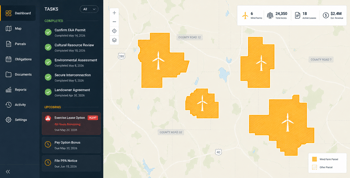
In renewables, the map is the record. If a landman can't see the lease boundaries overlaid with the proposed turbine locations in real-time, errors will occur. The U.S. Office of Energy Efficiency & Renewable Energy emphasizes that streamlined land use planning is a primary factor in reducing the "soft costs" of renewable energy. Digital integration is the only way to achieve this.
What PakEnergy Enables for Renewables
At PakEnergy, we built our reputation on being "Oil and Gas People." We understand the complexities of the American land system because we have lived it for over 35 years. As the industry evolves, so does our platform.
We enable renewable energy developers to adopt the rigorous, audit-ready workflows of the oil and gas industry for the new energy economy. Our software provides a "Single Source of Truth" that bridges the gap between different departments.
- For Land Teams: We provide automated lease and obligation tracking that handles the unique milestone payments of solar and wind contracts.
- For Executives: We offer real-time visibility into the development pipeline. You can see which projects are stalled at the title stage and which are ready for construction.
- For Investors: We provide a transparent, SOX-ready record of every agreement, ensuring that your ESG (Environmental, Social, and Governance) data is backed by hard evidence.
When you use a platform designed for the complexities of the energy industry, you aren't just buying software. You are buying a process hardened by decades of operational reality.
Conclusion: The Path Forward
The transition from oil and gas landwork to renewables is a journey from the mineral estate to the surface, and from reactive management to proactive automation. The land professional of the future is a "Hybrid Energy Manager." They are as comfortable talking about transmission line capacity as they are about mineral severances.
The fundamental truth remains: the energy industry is built on land. To succeed in this new vertical, you need tools that are as flexible as the market and as reliable as the resource. By adopting an integrated, cloud-based approach, you can ensure that your land department remains a driver of value, no matter which way the wind blows.
Ready to Modernize Your Land Team?
Whether you are managing 10,000 mineral acres or 10,000 solar panels, "The Pak" has your back. Discover how PakEnergy can help you transition your landwork for the next generation of energy production.