Webinar - Introducing OnPing Plunger - Powered by Pak AI | Oct 29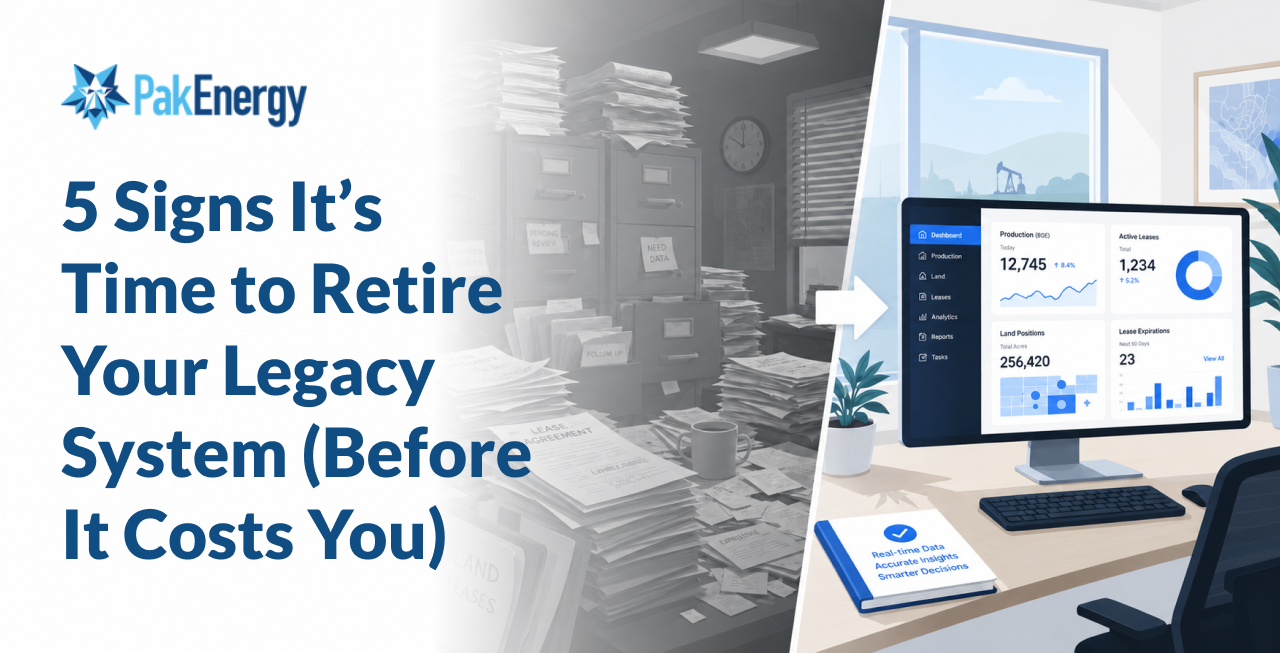
In the oil and gas industry, we often take pride in equipment that lasts. We value a pump jack that keeps rhythmic time for decades or a pipeline that stands the test of seasonal shifts. But when it comes to the software and systems managing the heartbeat of your business, longevity can quickly become a liability. The energy landscape in 2026 is moving faster than ever, driven by intensified compliance scrutiny, a tightening labor market, and a relentless pressure on margins.
Whether you are in the field, the back office, or the executive suite, you likely feel the friction of a system that was built for a different era of energy. The speed of decision-making is now a competitive differentiator. If your team is still waiting days for field tickets to be manually keyed into a legacy accounting system, or if your land department is manually tracking lease expirations on a wall calendar, you are not just working harder. You are exposing the company to risks that a modern, integrated platform is designed to eliminate.
Legacy systems hide their costs in the shadows of daily operations. These costs show up as data latency, compliance exposure, and an inability to scale during a period of aggressive acquisition. Identifying the tipping point at which your current setup moves from an asset to a threat is critical for long-term resilience
Sign 1: Data Latency is Slowing Your Response to the Field
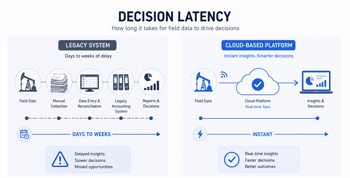 If your production data takes days or weeks to move from the wellhead to the ledger, you are driving your business by looking in the rearview mirror. In a legacy environment, data often exists in silos. Field pumpers record volumes on paper or in disconnected spreadsheets, which then travel through several hands before being entered into the central system.
This delay creates a gap where critical decisions are made based on stale information. If a well goes down or production drops unexpectedly, the financial impact might not be visible to leadership until the damage is already done. Real-time visibility is no longer a luxury. It is required to maintain operational efficiency and protect cash flow.
What it looks like: Your accounting team is still waiting for pumper tickets on the 10th of the month to close the previous cycle. Executives request current production totals and receive a report that is already 5 days old.
Why it matters: Data latency leads to missed optimization opportunities and increased downtime. According to the U.S. Energy Information Administration (EIA), accelerating the integration of data across energy agencies and operators is a primary focus for improving effectiveness in 2026.
Measurable indicator: The number of days between a field event (like a tank haul) and its appearance in your financial reporting. If this gap exceeds 24 to 48 hours, your system is creating a significant efficiency drag.
What to do next: Audit your current data flow. Identify every manual touchpoint where data is re-keyed or physically moved. This exercise often reveals the hidden "lag" that prevents your team from acting with precision.
Sign 2: Compliance Reporting Feels Like a Fire Drill
The regulatory environment in 2026 is characterized by "rigorous execution." From ESG reporting mandates to intensified methane oversight, the burden of proof is shifting toward the operator. If your compliance process involves a frantic scramble to gather data from multiple legacy databases and paper files, you are operating at a high level of risk.
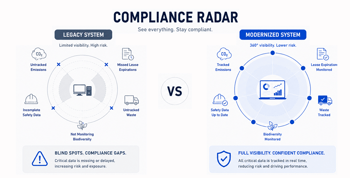 Legacy systems were rarely designed to handle the granular reporting requirements of modern environmental and safety standards. When reporting feels like a manual reconstruction project every quarter, the risk of human error skyrockets. In an era of high transparency, an "honest mistake" in a regulatory filing can still result in significant fines or a loss of investor confidence.
What it looks like: Your HSE and compliance teams spend weeks at the end of the year manually calculating emissions or safety metrics because the data was never captured at the source in a reportable format.
Why it matters: Modern oil and gas business automation enables proactive capture of compliance data. Voluntary safety and reporting programs are becoming the standard for identifying precursors to safety risks.
Source: [Bureau of Transportation Statistics]
Measurable indicator: The "time to report." Measure how many man-hours are required to produce a standard regulatory or ESG report. If the effort is expanding while your asset count stays the same, your legacy system is failing to keep pace with regulatory reality.
What to do next: Map your current reporting requirements against your system’s native data fields. If you find yourself consistently using "offline" spreadsheets to calculate compliance metrics, it is time to investigate an integrated energy platform.
Sign 3: You Are Managing Leases by Spreadsheet and Luck
Land management is the foundation of every upstream and midstream operation. However, legacy systems often treat land as a static record rather than a dynamic asset. If your land department is still relying on manual spreadsheets to track payment obligations, expirations, and provisions, you are one missed date away from a catastrophic loss of acreage.
As portfolios grow and become more complex, especially with the addition of renewable landwork or carbon capture acreage, manual tracking simply cannot scale. The complexity of modern leases, with their various shut-in provisions and depth severances, requires a system that provides automated alerts and 360 degree visibility across the entire lease lifecycle.
What it looks like: A pumper shuts in a well for maintenance without realizing it triggers a 90-day clock on a lease. The land department only finds out after the lease has lapsed because there was no automated connection between production and lease records.
Why it matters: Missing a lease expiration is one of the most expensive mistakes an operator can make. Modern land management software bridges the gap between field activity and legal obligations, ensuring that everyone from the pumper to the land manager is aligned on asset security.
Measurable indicator: The percentage of your lease records that are fully digitized and linked to automated alerts. If more than 20 percent of your land obligations rely on manual memory or standalone spreadsheets, the system is no longer protecting your assets.
What to do next: Evaluate your current "alert" system. If your alerts are not tied directly to your production data and your accounting system, you have a blind spot that legacy systems are notoriously unable to fix.
Sign 4: The Back Office is Buried in Rework and Manual Adjustments
A clear sign of a failing legacy system is the amount of time your accounting and land teams spend fixing errors. Rework is a silent profit killer. When land, production, and accounting data are siloed, the same data must be entered multiple times. This creates "data drift," where the well name in the field app doesn't match the well name in the accounting ERP.
These discrepancies lead to incorrect Joint Interest Billing (JIB) or royalty payments, requiring manual adjustments and "true-ups" in subsequent months. For leadership, this makes financial forecasting nearly impossible, as the numbers are constantly in flux due to retroactive corrections.
What it looks like: Your accounting team spends the first week of every month reconciling production volumes against owner distributions because the two systems don't talk to each other.
Why it matters: High volumes of manual adjustments are a red flag for auditors and partners. A modern upstream solution provides a single source of truth, ensuring that field-entered data flows seamlessly to the back office and eliminating the need for duplicative entry while reducing the risk of human error.
Measurable indicator: The ratio of manual journal entries to automated transactions. If your team is spending more time on corrections than on new entries, your technology is the bottleneck.
What to do next: Track the "life of a ticket." Pick a single field event and follow it through your organization. Count how many times that data is touched, moved, or edited. Each touchpoint is a potential failure point.
Sign 5: Scalability is Blocked by Administrative Headcount
Growth in the oil and gas industry often comes through acquisition. However, if your legacy system requires you to hire a new accountant or land tech for every ten new wells you acquire, you are not actually scaling. You are just bloating.
A truly modern system allows you to grow your asset count without a linear increase in your administrative overhead. Legacy systems often hit a ceiling where the complexity of the data becomes too much for the manual processes to handle. When this happens, growth slows, and the company becomes less attractive to investors and potential buyers who value lean, automated operations.
What it looks like: You pass on a potential acquisition because your back office is already "maxed out" and couldn't handle the integration of 100 new wells without months of manual data cleanup.
Why it matters: Scalability is about leverage. By investing in PakEnergy, you can integrate new assets in days rather than months. Automation allows your existing team to handle larger portfolios by focusing on managing exceptions rather than managing the data itself.
Measurable indicator: The "administrative cost per barrel." If this number is rising as you grow, your technology is preventing you from achieving economies of scale.
What to do next: Review your growth plan for the next 24 months. Ask your department heads if they can handle a 20 percent increase in volume today without adding new staff. If the answer is no, your legacy system is a barrier to your strategic goals.
Retiring the Legacy to Secure the Future
The decision to retire a legacy system is rarely about the software itself. It is a decision about the company's future. In 2026, the energy industry is being redefined by those who can harness data to drive efficiency and transparency. Holding on to an antiquated system is an intentional choice to accept higher risks and lower margins.
Modernization does not have to be a disruptive overhaul. It is an investment in a unified digital foundation that protects your land assets, streamlines your production, and makes your financial reporting audit-ready. The goal is to move from a defensive posture, where you are constantly reacting to data errors and compliance gaps, to an offensive posture, where you use real-time insights to find the next opportunity.
If you recognize these five signs in your own operation, it is a clear indicator that your legacy system has done its job and is now standing in the way of what comes next. Retiring it now ensures that, when the market moves, you have the digital agility to keep up.
Ready to take the next step?
See how PakEnergy can help you transition from legacy silos to a unified, cloud-based platform. Our team of oil and gas business process experts is ready to help you mitigate the risk and start the transformation.
Sources
- U.S. Energy Information Administration (EIA): Annual Energy Outlook 2026 Narrative and Data Integration Acceleration https://www.eia.gov/outlooks/aeo/narrative/
- U.S. Department of Transportation (DOT) Bureau of Transportation Statistics: Federal Register: Agency Information Collection Activities; Renewal of a Previously Approved Information Collection: Oil and Gas Industry Safety Data Program https://www.govinfo.gov/app/details/FR-2026-04-27/2026-08119
- PakEnergy Land Management Software: Cloud-based Oil and Gas Tech for Asset Protection and GIS Mapping https://pakenergy.com/land
- PakEnergy Upstream Solutions: Integrated ERP for Independent Oil and Gas Operators https://pakenergy.com/erp-upstream