Webinar - Introducing OnPing Plunger - Powered by Pak AI | Oct 29
In the oil and gas industry, the word "later" is often a polite way of saying "never." We see it all the time with digital transformation. An operator knows their accounting system is a patchwork of spreadsheets. They recognize their land department is drowning in paper leases. But with oil prices fluctuating and the field team already stretched thin, it feels easier to push the upgrade to next year.
The problem is that the market does not wait for next year. Forward-thinking operators are realizing that delaying technology investment is not a cost-saving measure. It is a form of operational debt that grows every day. In an era where efficiency is the primary driver of capital discipline, the gap between the digital "haves" and "have-nots" is becoming a chasm. Investing in oil and gas business automation today is no longer about being early. It is about staying in the game.
The Invisible Cost of Data Latency
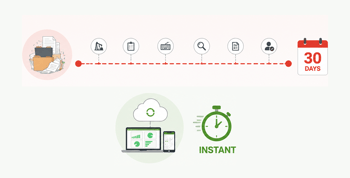 When you rely on manual processes, you are driving your business by looking in the rearview mirror. Field tickets are dropped off on Friday. They are entered into a spreadsheet on Monday. They might reach the accounting office by the following Thursday. By the time an Operations Director sees a production dip or a spike in chemical costs, the problem is already two weeks old.
This is the data latency trap. According to the U.S. Energy Information Administration (EIA), market volatility requires producers to be more agile than ever before. If your data is ten days behind, you cannot be agile. Real-time production reporting lets you catch issues at the wellhead as they occur. Whether it is a pump that went down at 2:00 AM or a tank haul that was never recorded, seeing it now lets you fix it quickly and helps mitigate more damage. Delaying this visibility means you are leaving money in the field.
Compliance and Regulatory Exposure
The regulatory environment is not getting simpler. From new methane-emission standards to complex escheatment rules across 50 different states, the burden of proof is on the operator. Manual systems are inherently audit-vulnerable. If a joint interest partner or a state regulator asks for a defensible trail of transactions from three years ago, can you find it in five minutes or five days?
Forward-thinking operators invest in tech to achieve "Audit-Readiness." An integrated platform creates an unalterable trail of every lease obligation, royalty payment, and production volume. This reduces the risk of expensive fines and protects your "Social License to Operate." In a world where transparency is required to secure capital, a digital back office is your best insurance policy.
Solving the Labor Constraint
Every operator is feeling the talent squeeze. Specialized oil and gas accountants and experienced land professionals are harder to find. When you finally find a great hire, do you want them spending forty hours a week re-keying data from paper tickets into a legacy ERP?
Technology acts as a force multiplier. It allows a lean team to manage ten times the volume they could handle manually. When you automate the "messy" parts of the business, like revenue distribution or JIB (Joint Interest Billing) calculations, you free up your best people to focus on high-value strategy. Operators who invest in tech now are building a "Process-Culture" that survives even when key employees move on or retire.
The Missed Opportunity of Optimization
Delaying tech also means missing out on the compounding benefits of data. In the oilfield, optimization is a game of inches. It is about finding a way to reduce downtime by 2% or cut haul costs by 5%.
Modern platforms use predictive analytics to identify patterns that a human eye might miss in a spreadsheet. For example, by integrating land management software with production data, you can see exactly which leases are underperforming relative to their royalty obligations. This allows you to make informed decisions about workovers or divestitures. When you wait to invest in tech, you aren't just delaying a software purchase. You are delaying the insights that could transform your P&L.
Rework and the Cost of Human Error
Human error is the most expensive line item that never shows up on a budget. A typo in a decimal point on a revenue check or a missed lease expiration date can cost an operator hundreds of thousands of dollars.
In a manual system, every hand-off is a potential source of error. The pumper writes it down. The foreman types it up. The accountant re-enters it. By the time it hits the final report, it has been handled three or four times. A unified PakEnergy platform eliminates these hand-offs. The data is captured once at the source and flows through the entire system without being re-keyed. Reducing rework is one of the fastest ways to improve your bottom line, but you need the digital infrastructure in place to do so.
The "FOMO" of Capital Access
Finally, we have to talk about the money. Whether you are looking for a bank loan, a private equity partner, or an acquisition target, the first thing they will look at is your data. In 2026, investors are wary of companies with "dark data"—information that exists but is unorganized or inaccessible.
Providing a clean, digital record of your well lifecycle management and financial performance builds instant credibility. It shows that you have control over your operations. Forward-thinking operators are investing in tech now because they know it makes their company more valuable. It is the difference between a "standard" valuation and a "premium" one.
Conclusion: The Time is Now
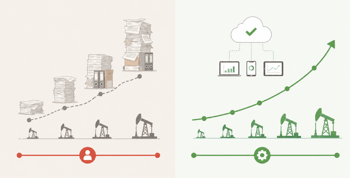 The energy transition is not just about moving from oil to solar. It is about moving from "Good Enough" to "Best-in-Class." The technology exists today to unify your field and office teams, automate your most complex workflows, and provide total visibility into your assets.
If you wait until you "have more time," you will never do it. The most successful operators we work with are the ones who decided that the risk of staying the same was greater than the risk of moving forward. They didn't wait for a "perfect" market. They built a system that could handle any market.
At PakEnergy, we have spent 35 years helping operators make this transition. We understand the field because we are oil and gas people. We know that "The Pak has your back" isn't just a slogan; it is a commitment to your long-term resilience. Don't let your competition get a digital head start. Start the conversation today.
Sources
- U.S. Energy Information Administration (EIA): Short-Term Energy Outlook and Market Volatility Reports https://www.eia.gov/outlooks/steo/
- PakEnergy Upstream Solutions: End-to-End Automation for Independent Operators https://pakenergy.com/erp-upstream
- PakEnergy Land Management: Automated Workflows and GIS for Land Teams https://pakenergy.com/land